A PIB Backgrounder released on 16 November 2026 reviewed the Forest Rights Act (FRA), 2006
DDecode Civils
· 4 min read
Forest Rights Act, 2006: Rights and Progress
Why in News
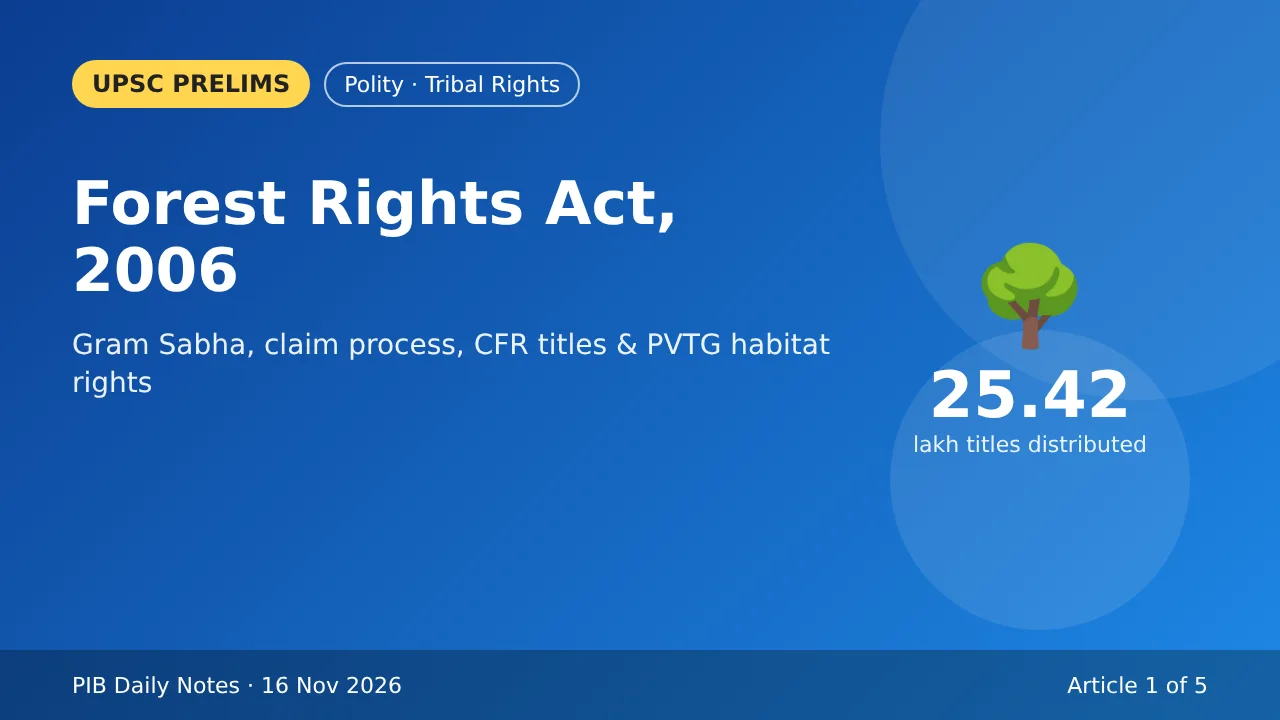
A PIB Backgrounder released on 16 November 2026 reviewed the Forest Rights Act (FRA), 2006. As on 31 August 2026, 25.42 lakh titles covering nearly 238 lakh acres had been distributed. The Ministry launched a National FRA Digital Platform during Janjatiya Gaurav Pakhwada (1–15 November 2026).
News Summary
The FRA recognises the rights of forest-dwelling Scheduled Tribes and other traditional forest dwellers over forest land that went unrecorded during colonial and later forest consolidation.
It got the President's assent on 29 December 2006 and came into force on 31 December 2007.
The Ministry of Tribal Affairs is the nodal agency. States and UTs implement it. It is being implemented in 20 states and one UT (J&K).
Progress up to 31 August 2026:
About 54 lakh claims received
43.56 lakh (80.64%) disposed of
24.18 lakh individual and 1.24 lakh community titles
Top states by titles: Chhattisgarh, Odisha, Madhya Pradesh, Telangana and Andhra Pradesh.
Habitat rights have been granted to 11 PVTGs in Odisha, Chhattisgarh and Madhya Pradesh.
The new digital platform will handle a claim from Gram Sabha submission to a digitally signed title.
Prelims Facts & Static Linkages
Who can claim
Forest-dwelling STs: members of Scheduled Tribes who mainly live in and depend on forests.
Other traditional forest dwellers: people who have lived in and depended on forests for at least three generations (75 years) before 13 December 2005.
Only land occupied before 13 December 2005 counts, up to a maximum of 4 hectares.
Rights apply to all forest land, including reserved and protected forests, sanctuaries and national parks.
No one can be evicted until verification of their rights is complete.
Three kinds of title
Individual title: for land lived on or farmed, up to 4 ha, in the joint names of both spouses.
Community forest rights (CFR) title: for grazing, fishing, water bodies and minor forest produce.
Community forest resource title: lets the Gram Sabha protect, regenerate, conserve and manage the forest within its customary boundary.
A title can be inherited but cannot be sold or transferred.
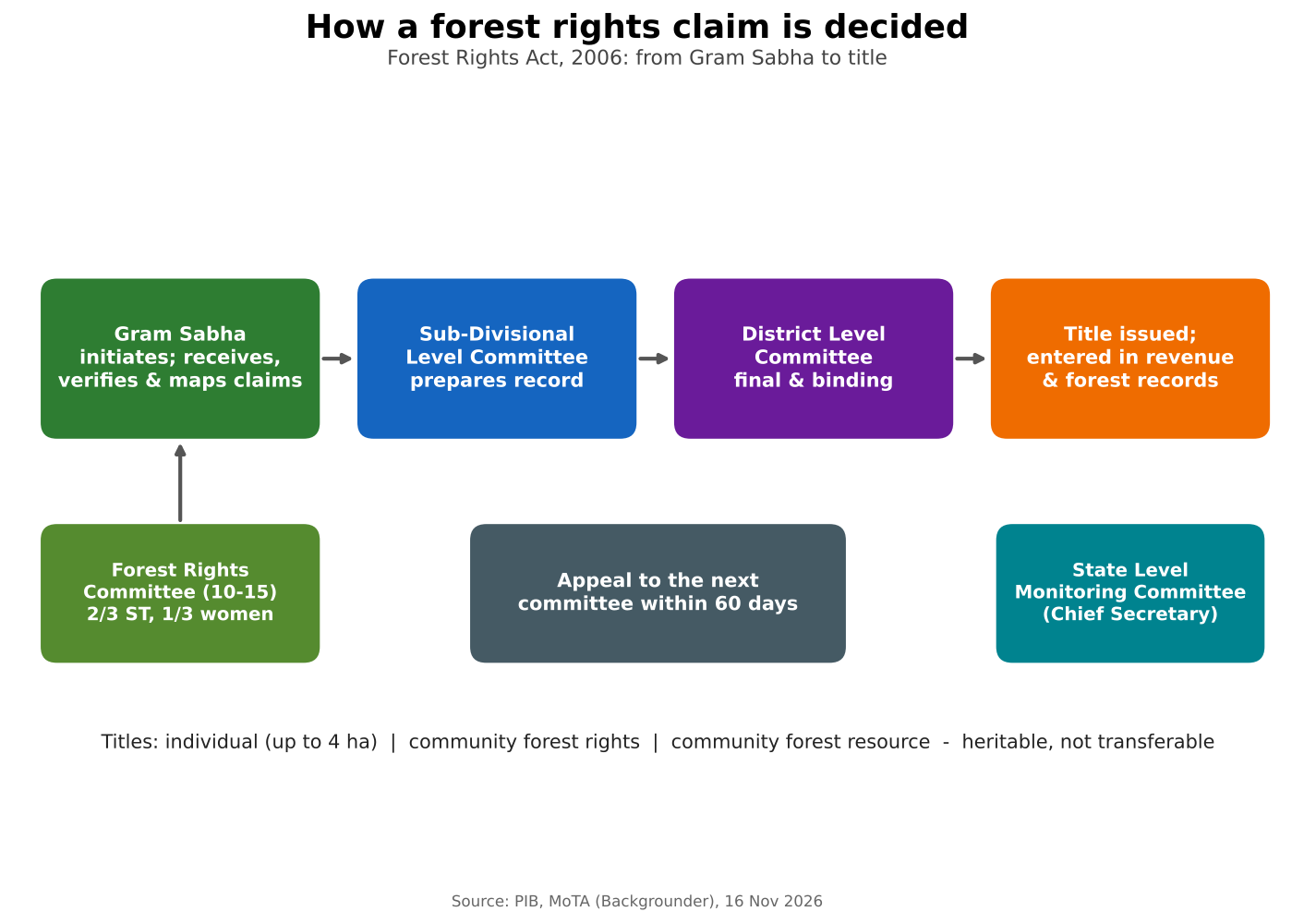
The claim process
Body
Role
Gram Sabha
Starts the process; receives and verifies claims and passes a resolution
Forest Rights Committee
10–15 members elected by the Gram Sabha; at least two-thirds STs and one-third women
Sub-Divisional Level Committee (SDLC)
Examines the resolution and prepares the record of rights
District Level Committee (DLC)
Its decision is final and binding
State Level Monitoring Committee
Chaired by the Chief Secretary; monitors progress
Appeals go to the next committee within 60 days.
Other key points
Minor forest produce such as bamboo, honey, lac and tendu leaves is owned by forest dwellers.
Up to 1 ha of forest land can be diverted for public facilities such as schools and hospitals, on the Gram Sabha's recommendation.
PVTGs: India has 75 Particularly Vulnerable Tribal Groups. The category comes from the Dhebar Commission (1960–61).
Janjatiya Gaurav Divas is on 15 November, the birth anniversary of Birsa Munda.
Quick Revision
The FRA was enacted in 2006 and came into force on 31 December 2007.
The cut-off date for claims is 13 December 2005.
The Gram Sabha starts the process, and the DLC's decision is final.
Individual titles are capped at 4 hectares.
Chhattisgarh has distributed the most titles.
Practice MCQ
Q. With reference to the Forest Rights Act, 2006, consider the following statements:
1. Rights can be recognised in national parks and wildlife sanctuaries.
2. A forest rights title can be sold to a non-tribal person.
3. Other traditional forest dwellers must show dependence on forests for at least three generations.
Which of the statements given above are correct?
(a) 1 and 2 only
(b) 1 and 3 only
(c) 2 and 3 only
(d) 1, 2 and 3
Answer: (b). Titles are heritable but not transferable.
Related PYQs
PYQ 1 (UPSC CSE Prelims 2013)
Under the Scheduled Tribes and Other Traditional Forest Dwellers (Recognition of Forest Rights) Act, 2006, who shall be the authority to initiate the process for determining the nature and extent of individual or community forest rights or both?
(a) State Forest Department
(b) District Collector/Deputy Commissioner
(c) Tahsildar/Block Development Officer/Mandal Revenue Officer
(d) Gram Sabha
Answer: (d).
PYQ 2 (UPSC CSE Prelims 2019)
Consider the following statements:
1. As per recent amendment to the Indian Forest Act, 1927, forest dwellers have the right to fell the bamboos grown on forest areas.
2. As per the Scheduled Tribes and Other Traditional Forest Dwellers (Recognition of Forest Rights) Act, 2006, bamboo is a minor forest produce.
3. The Scheduled Tribes and Other Traditional Forest Dwellers (Recognition of Forest Rights) Act, 2006 allows ownership of minor forest produce to forest dwellers.
Which of the statements given above is/are correct?



 24
Nov 2026
 24
Nov 2026
 24
Nov 2026














0 comments
Discussion
No comments yet. Be the first.