
How to Choose Your Optional Subject for UPSC Mains?
With 500 marks distributed across two papers of 250 marks each, the optional subject significantly influences a candidate's final Mains score.

How to Choose Your Optional Subject for UPSC Mains? A Complete Beginner's Guide
Choosing the right optional subject is one of the most important decisions in UPSC Civil Services Examination preparation. With 500 marks distributed across two papers of 250 marks each, the optional subject significantly influences a candidate's final Mains score.
However, beginners frequently select optional subjects based on popularity, perceived scoring potential or recommendations from successful candidates. A better approach involves evaluating personal interest, syllabus requirements, available resources and preparation time.
1. Prioritise Your Interest and Aptitude
Interest should be the primary consideration because optional preparation demands sustained reading, conceptual understanding and analytical writing.
Before selecting a subject, ask yourself:
Do I genuinely enjoy studying this subject?
Can I understand its fundamental concepts?
Am I comfortable writing analytical answers on its topics?
Can I sustain interest throughout preparation?
2. Analyse the Complete Optional Syllabus
Never choose an optional subject merely because its syllabus appears shorter.
Download the official syllabus and examine:
Number of topics across Paper I and Paper II.
Conceptual difficulty and depth of coverage.
Static versus contemporary components.
Time required for completing both papers.
Scope for revision and answer-writing practice.
A relatively short syllabus may contain complex philosophical or technical concepts, while a longer syllabus may be easier for someone with relevant academic knowledge.
3. Evaluate Overlap With General Studies
Some optional subjects overlap considerably with GS, Essay and Current Affairs.
| Optional subject | Relevant GS overlap |
|---|---|
| Political Science & IR | GS-II, International Relations |
| Sociology | GS-I, Social Issues, Essay |
| Geography | GS-I, GS-III, Environment |
| Public Administration | GS-II, Governance, Ethics |
| History | GS-I, Art and Culture |
| Anthropology | GS-I Society, selected science topics |
Overlap can reduce duplication of preparation, but it should not override interest and aptitude.
For instance, Mathematics has comparatively limited GS overlap, yet it may suit candidates with strong quantitative backgrounds.
4. Check Study Material and Guidance
Resource availability directly affects preparation efficiency, especially for beginners.
Before finalising an optional, verify whether you can access:
Standard textbooks and syllabus-wise notes.
Previous years' question papers.
Reliable lectures or mentorship, if required.
Topper answer copies and model answers.
Quality test series and answer evaluation.
A subject with good learning resources and reliable feedback may be easier to prepare systematically.
Explore Decode Civils' Optional Topper Strategies to understand different preparation approaches.
Decode Civils Free-for-all Initiatives & Study Material: This is a free-for-all course and provides exam-oriented strategies, analysis and resources for UPSC CSE 2027 & 2028 Aspirants. Click Here to Enroll for Free to Access the Same.
For easy access, the free-for-all material is segregated into 3 folders:
- Prelims: Booklist, 13 Types of MCQs, CSAT High Focus Areas, Polity High Focus Areas.
- Mains: Micro Topic Breakdown, Topic wise PYQ Segregation, Solved PYQs, PDFs of Mudit Sir's Books.
- Current Affairs: May-August Prelims + Mains Notes.
Strategies and Notes can be downloaded for free from relevant folder!
Click Here to Learn More About Decode Civils' UPSC Prelims 2027 Courses
5. Analyse Previous Years' Questions
PYQs provide the clearest indication of UPSC's actual expectations.
Examine at least five years of optional papers to understand:
Frequently tested themes.
Conceptual versus application-based questions.
Importance of contemporary examples.
Answer-writing and analytical requirements.
Whether questions match your knowledge and abilities.
6. Avoid the Myth of the Highest-Scoring Optional
Many beginners search for the highest-scoring or easiest UPSC optional subject.
However, the success of individual toppers cannot establish that a subject is consistently easier or more rewarding.
Optional scores depend on preparation quality, subject mastery, answer presentation and examination performance.
Avoid changing your optional simply because another subject has produced recent top ranks.
7. Follow a Seven-Day Optional Selection Exercise
Instead of making an immediate decision, shortlist two or three subjects.
| Days | Activity |
|---|---|
| Day 1 | Compare syllabi |
| Day 2 | Examine available books and resources |
| Day 3–4 | Study one introductory topic from each |
| Day 5 | Analyse PYQs |
| Day 6 | Attempt short answers |
| Day 7 | Compare comfort, interest and feasibility |
This exercise helps identify which subject feels manageable beyond its introductory chapters.
Conclusion: Choose According to Your Strengths
There is no universally best optional subject for UPSC. A suitable choice combines genuine interest, conceptual comfort, manageable syllabus coverage, reliable resources and the ability to write effective answers.
For first-time aspirants, selecting the optional early also allows sufficient time for multiple revisions and test practice.
Remember: Do not choose an optional because a topper succeeded with it. Choose one in which you can develop the knowledge and skills necessary to succeed.
Decode Civils Free-for-all Initiatives & Study Material: This is a free-for-all course and provides exam-oriented strategies, analysis and resources for UPSC CSE 2027 & 2028 Aspirants. Click Here to Enroll for Free to Access the Same.
For easy access, the free-for-all material is segregated into 3 folders:
- Prelims: Booklist, 13 Types of MCQs, CSAT High Focus Areas, Polity High Focus Areas.
- Mains: Micro Topic Breakdown, Topic wise PYQ Segregation, Solved PYQs, PDFs of Mudit Sir's Books.
- Current Affairs: May-August Prelims + Mains Notes.
Strategies and Notes can be downloaded for free from relevant folder!
Click Here to Learn More About Decode Civils' UPSC Prelims 2027 Courses
Downloads
Most read on Mudit Jain Blogs
- 2026 UPSC CSE Prelims GS Detailed Analysis Analysis
- Booklist & Sources for UPSC Prelims 2027 Prelims
- UPSC Prelims - Types of Questions Asked 2013 Onwards Analysis
- 2026 UPSC CSE Prelims CSAT Detailed Analysis Analysis
- 2013-2025 UPSC Mains GS-2 PYQs Analysis Analysis
- K.N.Chandana Jahnavi (CSE-23 AIR-50) Comprehensive and Sociology Strategy Topper Strategies
- 2013-2025 UPSC Mains GS-1 PYQs Analysis Analysis
- Prajnanandan Giri (CSE-23 AIR-24) Journey, Geography & Comprehensive Strategy Topper Strategies
- Aditi Varshney (AIR-57 CSE-22) Comprehensive Strategy Topper Strategies
- Jatin Jain (AIR-91 CSE-22) Sociology + Comprehensive Strategy Topper Strategies
Preparing for UPSC?
Talk to us about the right programme for your attempt.
Keep reading
Related articles
 19
Nov 2026
Foundation · Mains
Prelims and Mains: Integrated Preparation Strategy
Many beginners make the mistake of preparing for these examinations separately. However, both stages share substantial syllabus overlap. An integrated preparation strategy helps
Decode Civils · 19 Nov 2026
 19
Nov 2026
Foundation · Prelims
How to Use UPSC PYQs Effectively?
Sourabh Arbole Sir, who has cleared all six of his UPSC Prelims attempts, advocates a deeper approach. His methodology focuses on understanding how UPSC
Decode Civils · 19 Nov 2026
 19
Nov 2026
Foundation · Prelims
Newspaper and Current Affairs Strategy for UPSC Beginners: Mudit Jain (Ex-IPS, Ex-IRS)
Mudit Jain (Ex-IPS, Ex-IRS), who cleared UPSC CSE three times with AIR 222, 207 and 173, emphasises comprehensive coverage, linking Current Affairs with static subjects, systematic revision and question-based practice.
Decode Civils · 19 Nov 2026
Our programmes
Courses for your attempt
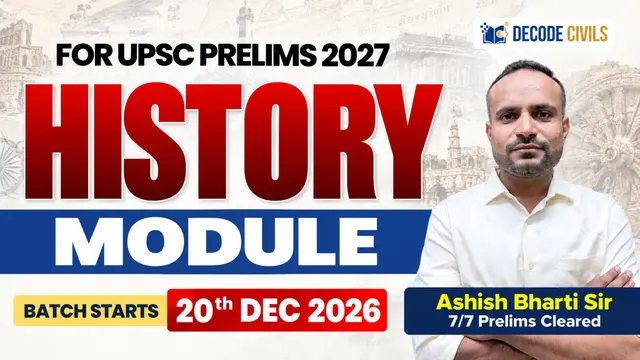
History Module For Prelims 2027
The toughest part of Prelims, simplified by someone who has cleared Prelims 7 out of 7 times.
History Starts 20 Dec 2026
₹2,359 ₹2,949
Learn More: History Module For Prelims 2027
Current Affairs For Prelims 2027 (Plus)
The only current affairs course with direct hits in UPSC Prelims
CA Plus Starts 4 Jan 2027
₹4,129 ₹4,719
Learn More: Current Affairs For Prelims 2027 (Plus)
Current Affairs For Prelims 2027 (Base)
The only current affairs course with direct hits in UPSC Prelims
CA Base Starts 4 Jan 2027
₹3,539 ₹4,129
Learn More: Current Affairs For Prelims 2027 (Base)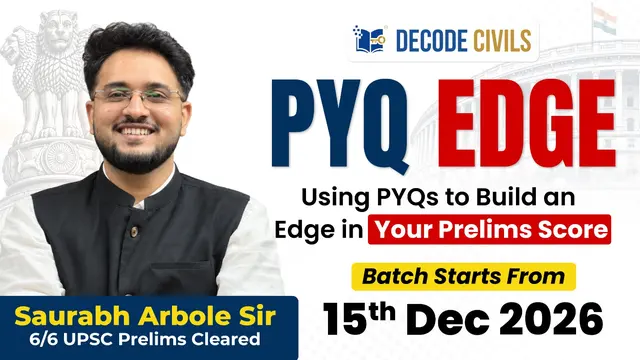
PYQ Edge
A PYQ mastery program: use PYQs to build an edge in your Prelims score
PYQ Edge Starts 15 Dec 2026
₹2,359 ₹2,949
Learn More: PYQ Edge
Prelims Excellence Program 2027 (Pro)
Your One Stop Solution For Prelims 2027
PEP Pro Starts 20 Nov 2026
₹20,059 ₹22,419
Learn More: Prelims Excellence Program 2027 (Pro)
Prelims Excellence Program 2027 (Plus)
Your One Stop Solution For Prelims 2027
PEP Plus Starts 20 Nov 2026
₹11,799 10618.82
Learn More: Prelims Excellence Program 2027 (Plus)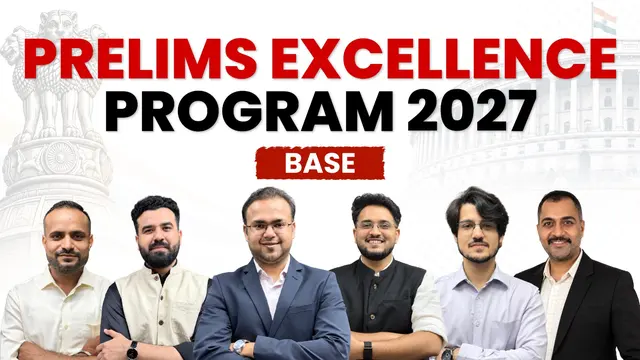
Prelims Excellence Program 2027 (Base)
Your One Stop Solution For Prelims 2027
PEP Base Starts 20 Nov 2026
₹7,079 ₹8,259
Learn More: Prelims Excellence Program 2027 (Base)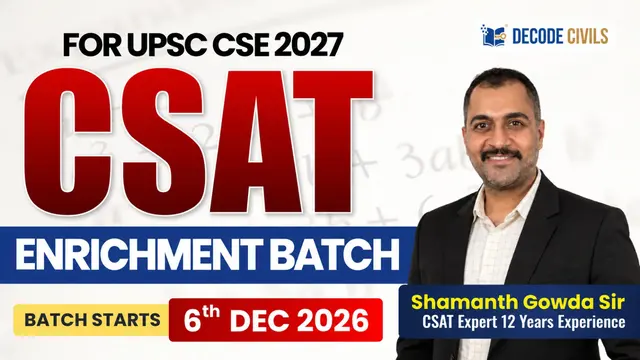
CSAT Enrichment Batch
Master the art and science of solving CSAT
₹2,359 ₹2,949
Learn More: CSAT Enrichment Batch
CSAT WEEKEND BATCH
Master CSAT for UPSC Prelims 2027 with expert guidance, focused practice, and mock tests.
CSAT WEEKEND BATCH Starts 31 Oct 2026
₹5,899 ₹8,259
Learn More: CSAT WEEKEND BATCH
ANTHROPOLOGY THROUGH PYQ's
Understand what UPSC asks and how to answer it from the Anthro Topper.
₹5,899 ₹8,259
Learn More: ANTHROPOLOGY THROUGH PYQ's
PSIR EXCELLENCE PROGRAM PRO (OFFLINE): Batch-2
An Enrichment Course that can help you add 50+ marks in your PSIR Scores.
PSIR EXCELLENCE PROGRAM PRO (ONLINE): Batch-2
An Enrichment Course that can help you add 50+ marks in your PSIR Scores.


0 comments
Discussion
No comments yet. Be the first.