
Prelims and Mains: Integrated Preparation Strategy
Many beginners make the mistake of preparing for these examinations separately. However, both stages share substantial syllabus overlap. An integrated preparation strategy helps


Prelims and Mains: Integrated Preparation Strategy for UPSC Aspirants
UPSC Civil Services Examination preparation requires clearing two distinct written stages: Prelims, which tests knowledge, accuracy and elimination skills, and Mains, which evaluates analytical understanding, critical thinking and answer-writing ability.
Many beginners make the mistake of preparing for these examinations separately. However, both stages share substantial syllabus overlap. An integrated preparation strategy helps aspirants build conceptual clarity, save time and develop examination-specific skills simultaneously.
1. Understand the Difference Between Prelims and Mains
Although both examinations cover similar subjects, their demands differ significantly.
| Prelims | Mains |
|---|---|
| Objective MCQs | Descriptive answers |
| Factual and conceptual accuracy | Analytical understanding |
| Elimination techniques | Structured arguments |
| Speed and question selection | Content and time management |
| Broad syllabus coverage | Depth and multidimensional analysis |
The key is to study the same topic once but practise applying it in both formats.
2. Begin With Common General Studies Subjects
Start preparation with subjects that have significant overlap.
Polity: Constitution, Parliament, Judiciary and federalism.
History: Modern India, freedom struggle and cultural heritage.
Geography: Physical geography, Indian geography and resources.
Economy: Inflation, monetary policy, growth and development.
Environment: Biodiversity, climate change and conservation.
For example, while studying Fundamental Rights, learn constitutional articles for Prelims and examine their interpretation, limitations and contemporary relevance for Mains.
This approach prevents unnecessary duplication of notes.
3. Integrate PYQs Into Every Subject
Previous Year Questions (PYQs) help aspirants understand how UPSC evaluates the same concept differently.
Follow these steps:
Complete a topic using standard textbooks.
Solve relevant Prelims PYQs.
Identify recurring facts and conceptual traps.
Examine Mains PYQs from the same topic.
Prepare a short answer framework.
For instance, questions on biodiversity may test protected-area classifications in Prelims, while Mains may examine conservation challenges and policy effectiveness.
Analyse PYQs before making extensive notes.
4. Prepare Integrated Notes for Both Stages
Avoid maintaining entirely separate notebooks for Prelims and Mains.
Prepare subject-wise notes containing:
Prelims component: Definitions, facts, articles, institutions and classifications.
Mains component: Causes, implications, challenges, examples and solutions.
Current Affairs: Important developments linked with static concepts.
PYQs: Previously examined themes and questions.
Keep notes concise enough for multiple revisions.
Decode Civils Free-for-all Initiatives & Study Material: This is a free-for-all course and provides exam-oriented strategies, analysis and resources for UPSC CSE 2027 & 2028 Aspirants. Click Here to Enroll for Free to Access the Same.
For easy access, the free-for-all material is segregated into 3 folders:
- Prelims: Booklist, 13 Types of MCQs, CSAT High Focus Areas, Polity High Focus Areas.
- Mains: Micro Topic Breakdown, Topic wise PYQ Segregation, Solved PYQs, PDFs of Mudit Sir's Books.
- Current Affairs: May-August Prelims + Mains Notes.
Strategies and Notes can be downloaded for free from relevant folder!
Click Here to Learn More About Decode Civils' UPSC Prelims 2027 Courses
5. Balance MCQs and Answer Writing
Aspirants should practise both objective and descriptive questions throughout preparation.
For Prelims:
Solve 15–25 topic-wise MCQs regularly.
Develop elimination techniques.
Analyse incorrect answers and guesses.
Practise CSAT comprehension, reasoning and numeracy.
For Mains:
Begin with one answer every alternate day after developing basic conceptual understanding.
Gradually increase to 2–3 answers daily.
Use introduction–body–conclusion structures.
Incorporate relevant examples, diagrams and balanced conclusions.
Quality of analysis matters more than the quantity of questions attempted.
6. Follow an Integrated Daily Study Timetable
A practical eight-hour timetable for full-time beginners is:
| Activity | Daily allocation |
|---|---|
| Core GS subjects | 3 hours |
| Optional subject | 2 hours |
| Current Affairs | 1 hour |
| Prelims MCQs / CSAT | 1 hour |
| Mains writing / revision | 1 hour |
| Total | 8 hours |
Alternate CSAT and MCQ sessions according to individual weaknesses. Reserve weekly sessions for Essay and Ethics.
7. Change Priorities as Prelims Approaches
Integrated preparation does not mean allocating equal time to both stages throughout the year.
A practical approach is:
Early preparation: Focus on foundational GS, Optional and Mains-oriented understanding.
Approximately 100–120 days before Prelims: Prioritise Prelims revision, MCQs, CSAT and mocks.
After Prelims: Immediately intensify Mains preparation, particularly answer writing, Optional, Essay and Ethics.
These timelines are illustrative and should be adjusted to the official examination calendar and individual readiness.
8. Avoid Common Preparation Mistakes
Beginners should avoid:
Studying exclusively for Prelims throughout the year.
Postponing optional preparation until after Prelims.
Ignoring CSAT because it is qualifying.
Reading multiple books without sufficient revision.
Writing answers without understanding question demands.
Attempting mock tests without analysing mistakes.
Conclusion: One Foundation, Two Examination Approaches
Successful integrated preparation requires developing conceptual knowledge and applying it differently according to examination demands.
Use standard resources, connect static subjects with Current Affairs, analyse PYQs and practise both MCQs and descriptive answers.
Prepare the syllabus together, practise the examination formats separately and revise consistently.
This approach makes preparation more systematic and reduces the pressure of switching abruptly between Prelims and Mains.
Decode Civils Free-for-all Initiatives & Study Material: This is a free-for-all course and provides exam-oriented strategies, analysis and resources for UPSC CSE 2027 & 2028 Aspirants. Click Here to Enroll for Free to Access the Same.
For easy access, the free-for-all material is segregated into 3 folders:
- Prelims: Booklist, 13 Types of MCQs, CSAT High Focus Areas, Polity High Focus Areas.
- Mains: Micro Topic Breakdown, Topic wise PYQ Segregation, Solved PYQs, PDFs of Mudit Sir's Books.
- Current Affairs: May-August Prelims + Mains Notes.
Strategies and Notes can be downloaded for free from relevant folder!
Click Here to Learn More About Decode Civils' UPSC Prelims 2027 Courses
Downloads
Most read on Mudit Jain Blogs
- 2026 UPSC CSE Prelims GS Detailed Analysis Analysis
- Booklist & Sources for UPSC Prelims 2027 Prelims
- UPSC Prelims - Types of Questions Asked 2013 Onwards Analysis
- 2026 UPSC CSE Prelims CSAT Detailed Analysis Analysis
- 2013-2025 UPSC Mains GS-2 PYQs Analysis Analysis
- K.N.Chandana Jahnavi (CSE-23 AIR-50) Comprehensive and Sociology Strategy Topper Strategies
- 2013-2025 UPSC Mains GS-1 PYQs Analysis Analysis
- Prajnanandan Giri (CSE-23 AIR-24) Journey, Geography & Comprehensive Strategy Topper Strategies
- Aditi Varshney (AIR-57 CSE-22) Comprehensive Strategy Topper Strategies
- Jatin Jain (AIR-91 CSE-22) Sociology + Comprehensive Strategy Topper Strategies
Preparing for UPSC?
Talk to us about the right programme for your attempt.
Keep reading
Related articles
 19
Nov 2026
Foundation · Mains
How to Choose Your Optional Subject for UPSC Mains?
With 500 marks distributed across two papers of 250 marks each, the optional subject significantly influences a candidate's final Mains score.
Decode Civils · 19 Nov 2026
 19
Nov 2026
Foundation · Prelims
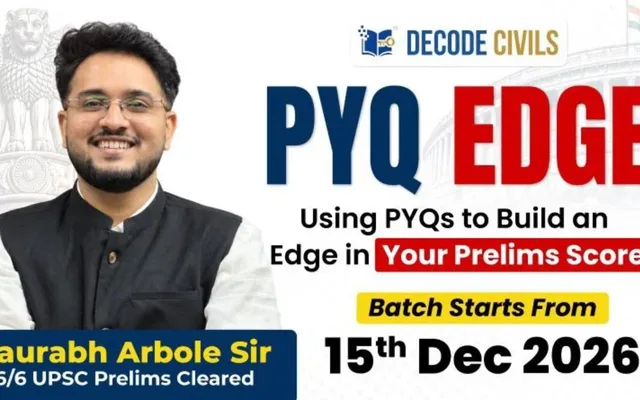
How to Use UPSC PYQs Effectively?
Sourabh Arbole Sir, who has cleared all six of his UPSC Prelims attempts, advocates a deeper approach. His methodology focuses on understanding how UPSC
Decode Civils · 19 Nov 2026
 19
Nov 2026
Foundation · Prelims
Newspaper and Current Affairs Strategy for UPSC Beginners: Mudit Jain (Ex-IPS, Ex-IRS)
Mudit Jain (Ex-IPS, Ex-IRS), who cleared UPSC CSE three times with AIR 222, 207 and 173, emphasises comprehensive coverage, linking Current Affairs with static subjects, systematic revision and question-based practice.
Decode Civils · 19 Nov 2026
Our programmes
Courses for your attempt

History Module For Prelims 2027
The toughest part of Prelims, simplified by someone who has cleared Prelims 7 out of 7 times.
History Starts 20 Dec 2026
₹2,359 ₹2,949
Learn More: History Module For Prelims 2027
Current Affairs For Prelims 2027 (Plus)
The only current affairs course with direct hits in UPSC Prelims
CA Plus Starts 4 Jan 2027
₹4,129 ₹4,719
Learn More: Current Affairs For Prelims 2027 (Plus)
Current Affairs For Prelims 2027 (Base)
The only current affairs course with direct hits in UPSC Prelims
CA Base Starts 4 Jan 2027
₹3,539 ₹4,129
Learn More: Current Affairs For Prelims 2027 (Base)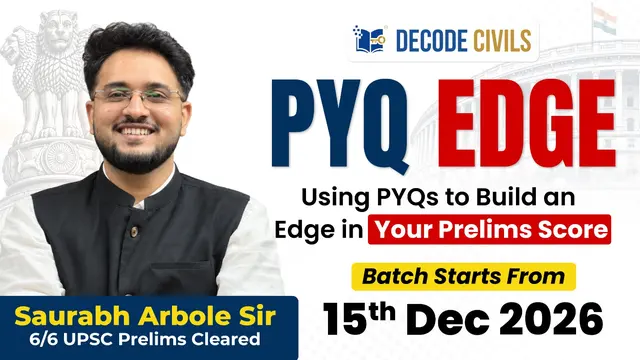
PYQ Edge
A PYQ mastery program: use PYQs to build an edge in your Prelims score
PYQ Edge Starts 15 Dec 2026
₹2,359 ₹2,949
Learn More: PYQ Edge
Prelims Excellence Program 2027 (Pro)
Your One Stop Solution For Prelims 2027
PEP Pro Starts 20 Nov 2026
₹20,059 ₹22,419
Learn More: Prelims Excellence Program 2027 (Pro)
Prelims Excellence Program 2027 (Plus)
Your One Stop Solution For Prelims 2027
PEP Plus Starts 20 Nov 2026
₹11,799 10618.82
Learn More: Prelims Excellence Program 2027 (Plus)
Prelims Excellence Program 2027 (Base)
Your One Stop Solution For Prelims 2027
PEP Base Starts 20 Nov 2026
₹7,079 ₹8,259
Learn More: Prelims Excellence Program 2027 (Base)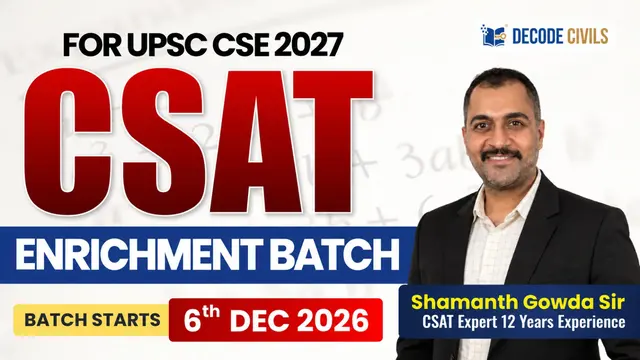
CSAT Enrichment Batch
Master the art and science of solving CSAT
₹2,359 ₹2,949
Learn More: CSAT Enrichment Batch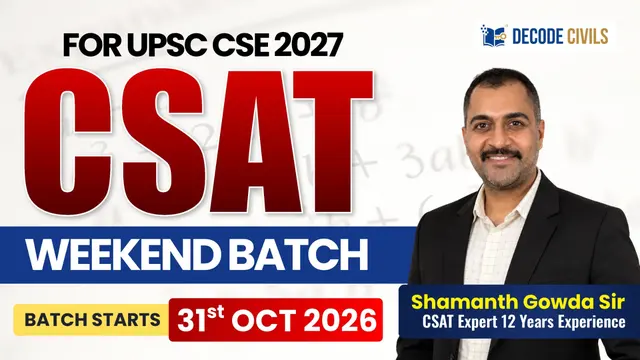
CSAT WEEKEND BATCH
Master CSAT for UPSC Prelims 2027 with expert guidance, focused practice, and mock tests.
CSAT WEEKEND BATCH Starts 31 Oct 2026
₹5,899 ₹8,259
Learn More: CSAT WEEKEND BATCH
ANTHROPOLOGY THROUGH PYQ's
Understand what UPSC asks and how to answer it from the Anthro Topper.
₹5,899 ₹8,259
Learn More: ANTHROPOLOGY THROUGH PYQ's
PSIR EXCELLENCE PROGRAM PRO (OFFLINE): Batch-2
An Enrichment Course that can help you add 50+ marks in your PSIR Scores.
PSIR EXCELLENCE PROGRAM PRO (ONLINE): Batch-2
An Enrichment Course that can help you add 50+ marks in your PSIR Scores.


0 comments
Discussion
No comments yet. Be the first.