India has given more than 1 crore doses of the Human Papillomavirus (HPV) vaccine in under nine months
DDecode Civils
· 3 min read
India Crosses 1 Crore HPV Vaccine Doses
Why in News
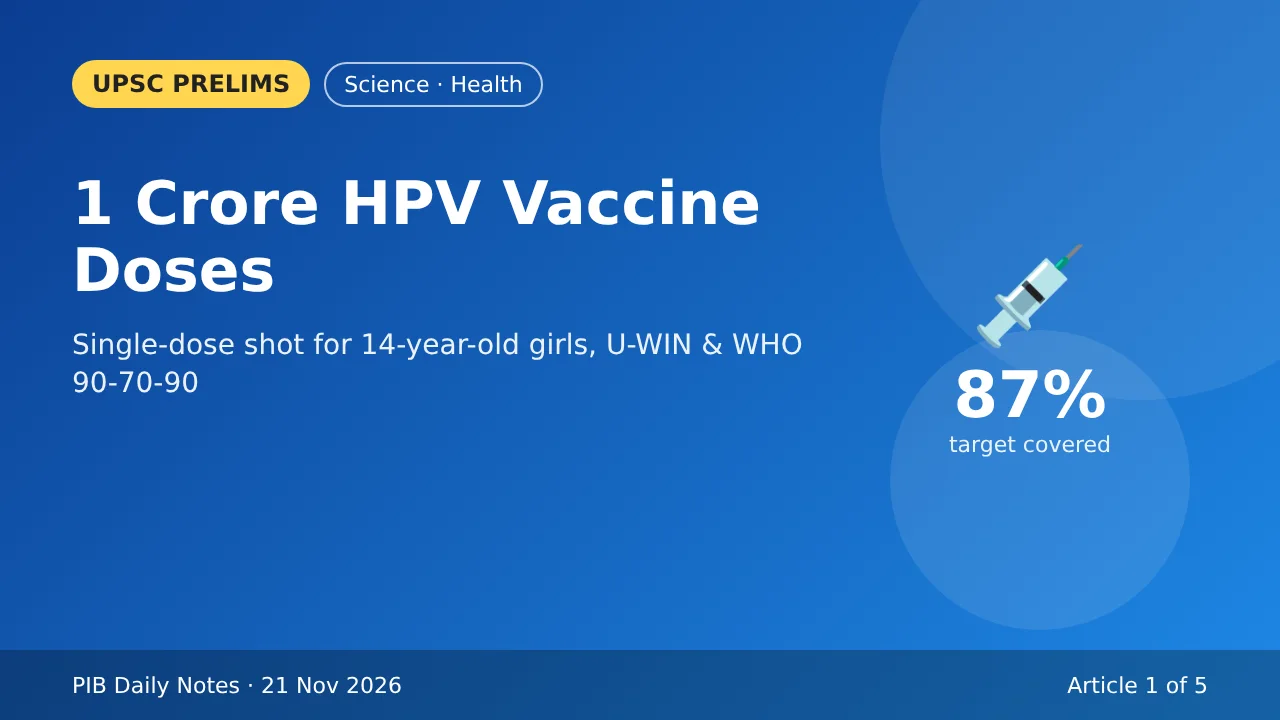
India has given more than 1 crore doses of the Human Papillomavirus (HPV) vaccine in under nine months of the National HPV Vaccination Campaign, which the Prime Minister launched in February 2026.
News Summary
The campaign offers a free, voluntary, single-dose HPV vaccine to 14-year-old girls, with parental consent, at government health facilities.
Coverage has reached nearly 87% of the annual target of about 1.2 crore girls, based on RGI 2021 population estimates.
Six states have reached 100% coverage: Gujarat, Uttar Pradesh, Andhra Pradesh, Mizoram, Madhya Pradesh and Bihar.
By number of girls vaccinated, Uttar Pradesh leads (29.33 lakh), followed by Bihar (13.70 lakh) and Gujarat (7.75 lakh).
The U-WIN platform handles slot booking, beneficiary tracking and digital certificates.
Every session runs under a trained Medical Officer and is linked to a 24×7 health centre that can manage AEFI (Adverse Events Following Immunization).
Prelims Facts & Static Linkages
HPV and cervical cancer: key facts
Item
Fact
Pathogen
Human Papillomavirus, a DNA virus spread through skin-to-skin (sexual) contact
High-risk types
HPV-16 and HPV-18 cause about 70% of cervical cancers worldwide
Burden in India
Cervical cancer is the 2nd most common cancer among Indian women, after breast cancer
Indigenous vaccine
Cervavac, a quadrivalent vaccine made by Serum Institute of India with DBT–BIRAC support (2022)
WHO position
A single dose gives protection comparable to two (WHO, 2022)
How the vaccine prevents cancer
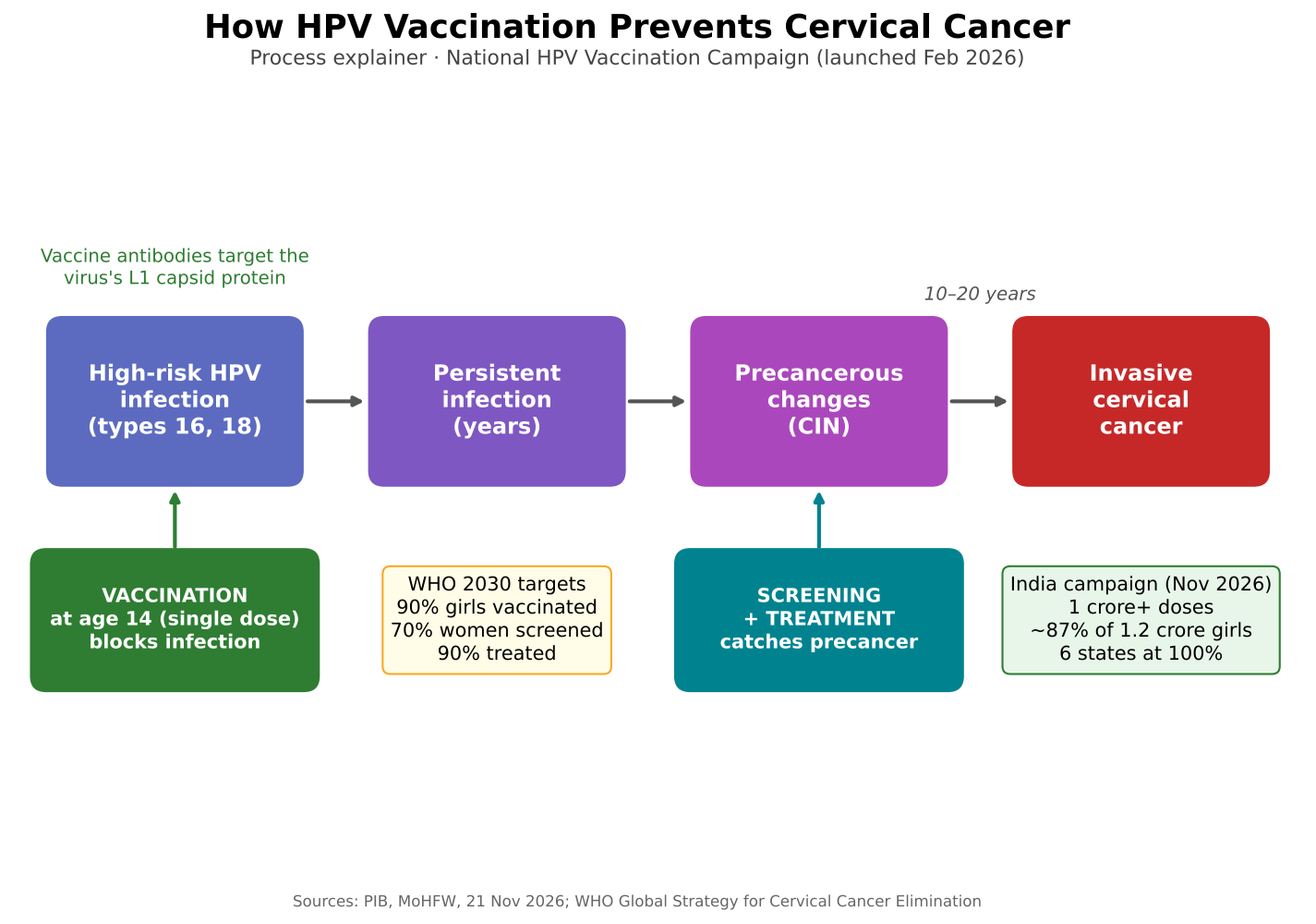
A high-risk HPV type infects cells of the cervix.
Most infections clear on their own, but some persist for years.
Without screening and treatment, these can turn into invasive cervical cancer over 10–20 years.
The vaccine makes the body produce antibodies against the virus's L1 capsid protein, so the infection never takes hold. This is why vaccination works best before any exposure, hence the age of 14.
WHO's 90-70-90 targets for 2030
Pillar
Target
Vaccination
90% of girls fully vaccinated by age 15
Screening
70% of women screened with a high-performance test by ages 35 and 45
Treatment
90% of women with cervical disease treated
India's immunisation framework
Universal Immunisation Programme (UIP): launched in 1985, building on the Expanded Programme on Immunisation of 1978.
Mission Indradhanush (2014): a drive to fully immunise children and pregnant women who had been missed.
U-WIN: the digital registry for UIP vaccinations, modelled on Co-WIN.
Likely Prelims angles
Which HPV types cause cancer, and whether HPV is a DNA or RNA virus
Cervavac and the institutions behind it
The WHO 90-70-90 strategy
U-WIN versus Co-WIN versus eVIN (vaccine logistics)
Quick Revision
Over 1 crore HPV doses were given within nine months of the February 2026 launch.
The target group is 14-year-old girls, with a single free dose.
Six states have reached 100% coverage, and Uttar Pradesh has vaccinated the most girls.
HPV-16 and HPV-18 are the main cancer-causing types.
Cervavac is India's first indigenous HPV vaccine.
The WHO's elimination target is 90-70-90 by 2030.
Practice MCQ
Q. Consider the following statements about the HPV vaccine:
HPV is an RNA virus.
Cervavac is a quadrivalent HPV vaccine developed in India.
The WHO accepts a single-dose schedule for HPV vaccination.
Which of the above are correct?
(a) 1 and 2 only
(b) 2 and 3 only
(c) 1 and 3 only
(d) 1, 2 and 3
Answer: (b). HPV is a DNA virus.
Related PYQs
PYQ 1 (UPSC CSE Prelims 2022)
In the context of vaccines manufactured to prevent COVID-19 pandemic, consider the following statements:
The Serum Institute of India produced COVID-19 vaccine named Covishield using mRNA platform.
Sputnik V vaccine is manufactured using vector based platform.
COVAXIN is an inactivated pathogen based vaccine developed by Bharat Biotech.
Which of the statements given above are correct?
(a) 1 and 2 only
(b) 2 and 3 only
(c) 1 and 3 only
(d) 1, 2 and 3
Answer: (b). Covishield uses a viral vector platform, not mRNA.



 24
Nov 2026
 24
Nov 2026
 24
Nov 2026














0 comments
Discussion
No comments yet. Be the first.