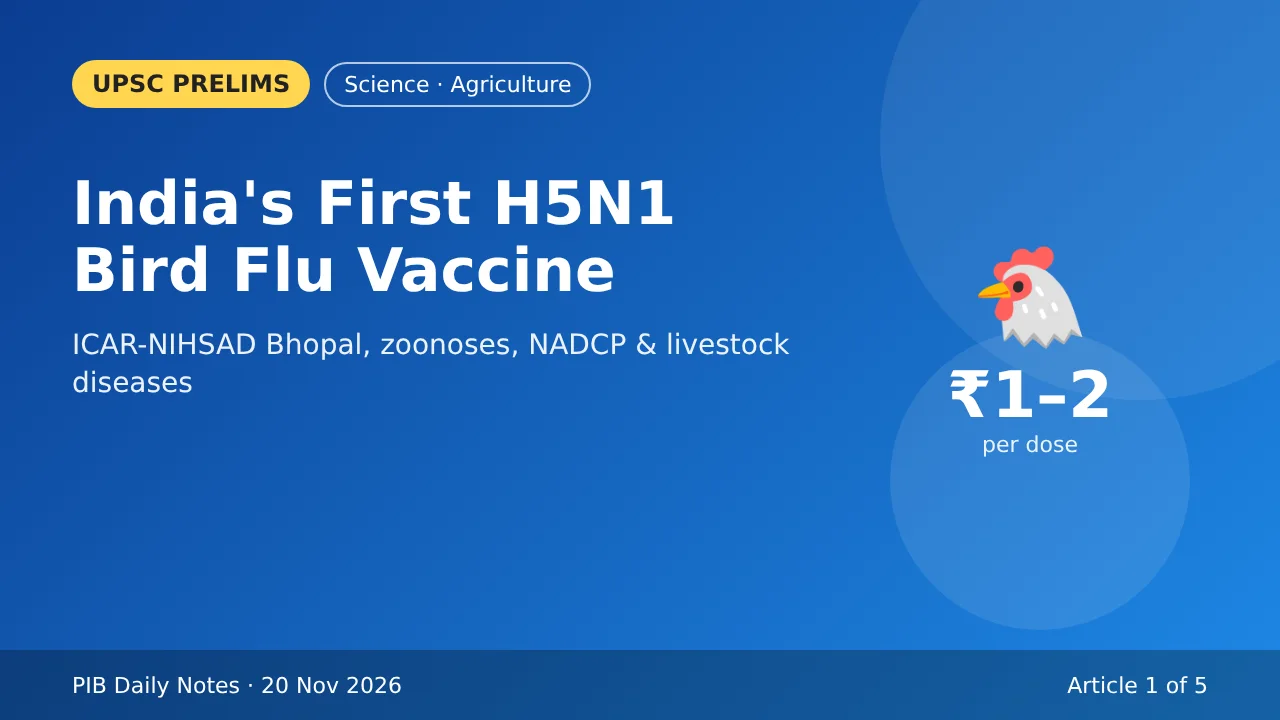
India's first indigenous chicken vaccine against Avian Influenza (H5N1), or bird flu by ICAR–National Institute of High Security Animal Diseases
DDecode Civils
· 4 min read
India's First Indigenous H5N1 Bird Flu Vaccine
Why in News
The Union Agriculture Minister dedicated to the nation India's first indigenous chicken vaccine against Avian Influenza (H5N1), or bird flu, in Bhopal. It was developed by ICAR–National Institute of High Security Animal Diseases (NIHSAD), Bhopal. A new ₹300 crore animal disease research laboratory was also announced for the city.
News Summary
The vaccine costs only ₹1–2 per dose, so that small poultry farmers can afford it.
The government describes it as the world's first vaccine against this particular variant of bird flu.
India's first bird flu outbreak was in 2006 at Navapur, Maharashtra, where about 10 lakh chickens died. There have been more than 500 outbreaks since then.
Animal husbandry contributes about 14% of GDP, and poultry about 1% more, according to the Minister.
Major livestock diseases cause losses of about ₹56,000 crore a year: FMD (₹22,000 cr), Lumpy Skin Disease (₹20,000 cr), Brucellosis (₹9,212 cr) and PPR (₹4,683 cr).
Under the National Animal Disease Control Programme (NADCP), about 147.16 crore free FMD vaccine doses have been given.
Prelims Facts & Static Linkages
Avian influenza at a glance
Item
Fact
Pathogen
Influenza A virus, an RNA virus
Naming
By two surface proteins: Haemagglutinin (H) and Neuraminidase (N), hence H5N1
Natural reservoir
Wild migratory waterfowl, which can carry the virus without falling ill
Type
Highly Pathogenic Avian Influenza (HPAI), which kills poultry quickly
Zoonotic?
Yes. It can jump to mammals and humans, though human-to-human spread is rare
Global reporting
A notifiable disease under the World Organisation for Animal Health (WOAH), formerly the OIE
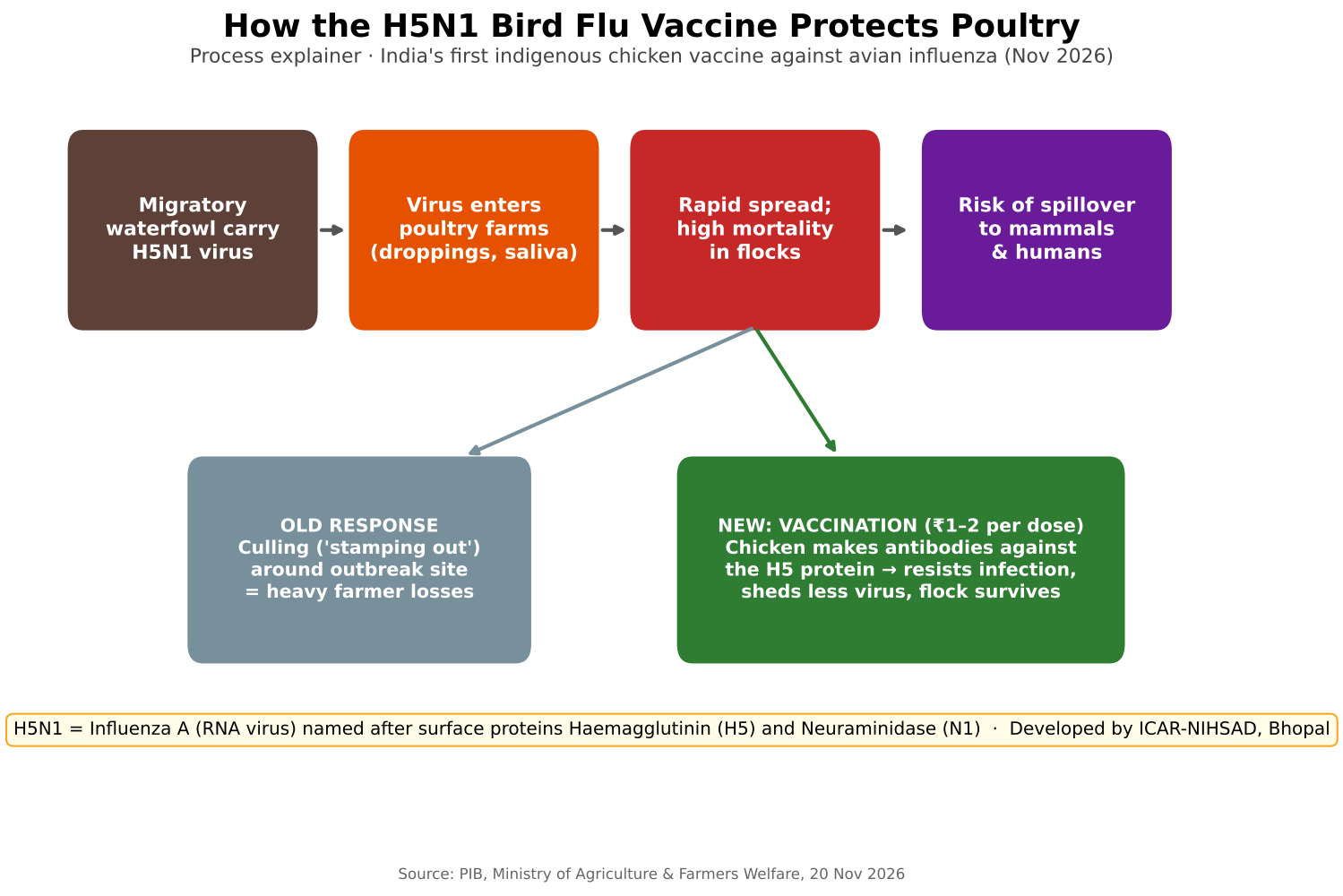
How the vaccine protects a flock
Migratory birds bring the virus into wetlands and backyard flocks.
Infected poultry shed the virus in droppings and saliva, so it spreads fast within a farm.
Without vaccination, control depends on culling ("stamping out") around the outbreak site, which hurts farmers badly.
The vaccine trains the chicken's immune system to produce antibodies against the H5 protein.
Vaccinated birds resist infection and shed less virus, which cuts farm losses and reduces the chance of spillover to humans.
NIHSAD Bhopal and other indigenous animal vaccines
NIHSAD is India's high-containment lab for exotic and emerging animal diseases, so bird flu samples are confirmed there.
Key concepts to revise
Zoonosis: a disease that passes from animals to humans, such as bird flu, Nipah and rabies.
One Health: an approach that treats human, animal and environmental health as linked.
NADCP (2019): a Central Sector scheme to control FMD and Brucellosis through mass vaccination.
PPR: a viral disease of sheep and goats, not of poultry.
Likely Prelims angles
What H and N stand for in flu virus names
Which institute is India's high-security animal disease lab
Diseases covered under NADCP
Matching livestock diseases with the animals they affect
Quick Revision
India's first indigenous H5N1 poultry vaccine was developed by ICAR-NIHSAD, Bhopal.
It costs ₹1–2 per dose.
India's first bird flu outbreak was at Navapur, Maharashtra, in 2006.
H5N1 is an RNA virus named after its haemagglutinin and neuraminidase proteins.
NADCP targets FMD and Brucellosis.
Lumpi-ProVacInd protects cattle against Lumpy Skin Disease.
Practice MCQ
Q. Consider the following statements:
Avian influenza viruses are DNA viruses.
The "H" in H5N1 refers to haemagglutinin, a surface protein of the virus.
Pestecides Petits Ruminants mainly affects sheep and goats.
Which of the statements given above are correct?
(a) 1 and 2 only
(b) 2 and 3 only
(c) 1 and 3 only
(d) 1, 2 and 3
Answer: (b). Influenza viruses are RNA viruses.
Related PYQs
PYQ 1 (UPSC CSE Prelims 2025)
Consider the following statements:
Statement I: In India, income from allied agricultural activities like poultry farming and wool rearing in rural areas is exempted from any tax.
Statement II: In India, rural agricultural land is not considered a capital asset under the provisions of the Income-tax Act, 1961.
Which one of the following is correct in respect of the above statements?
(a) Both Statement I and Statement II are correct and Statement II explains Statement I
(b) Both Statement I and Statement II are correct but Statement II does not explain Statement I
(c) Statement I is correct but Statement II is not correct
(d) Statement I is not correct but Statement II is correct
Answer: (d) Income from poultry is not agricultural income, so it is taxable, while rural agricultural land is excluded from the definition of a capital asset.



 24
Nov 2026
 24
Nov 2026
 24
Nov 2026














0 comments
Discussion
No comments yet. Be the first.