Retail Inflation at 6.09% on the New CPI Series (Base 2024)
MoSPI released the Consumer Price Index (CPI) on base 2024=100 for October 2026
DDecode Civils
· 3 min read
Retail Inflation at 6.09% on the New CPI Series (Base 2024)
Why in News
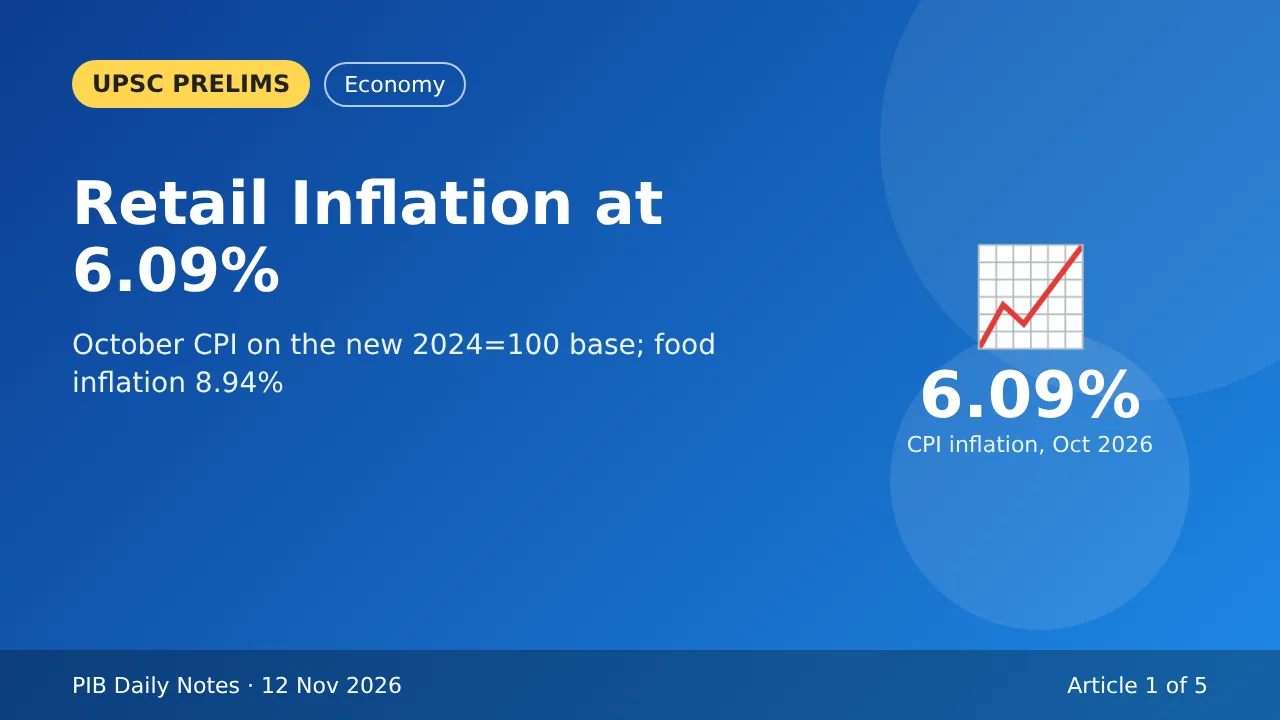
The Ministry of Statistics and Programme Implementation (MoSPI) released the Consumer Price Index (CPI) on base 2024=100 for October 2026. All-India retail inflation was 6.09% (provisional), up from 5.54% in September. Food inflation, measured by the Consumer Food Price Index (CFPI), rose to 8.94%.
Items in deflation: potato (-14.24%), cauliflower (-10.57%), coconut (-5.60%), brinjal (-3.34%) and cabbage (-1.92%).
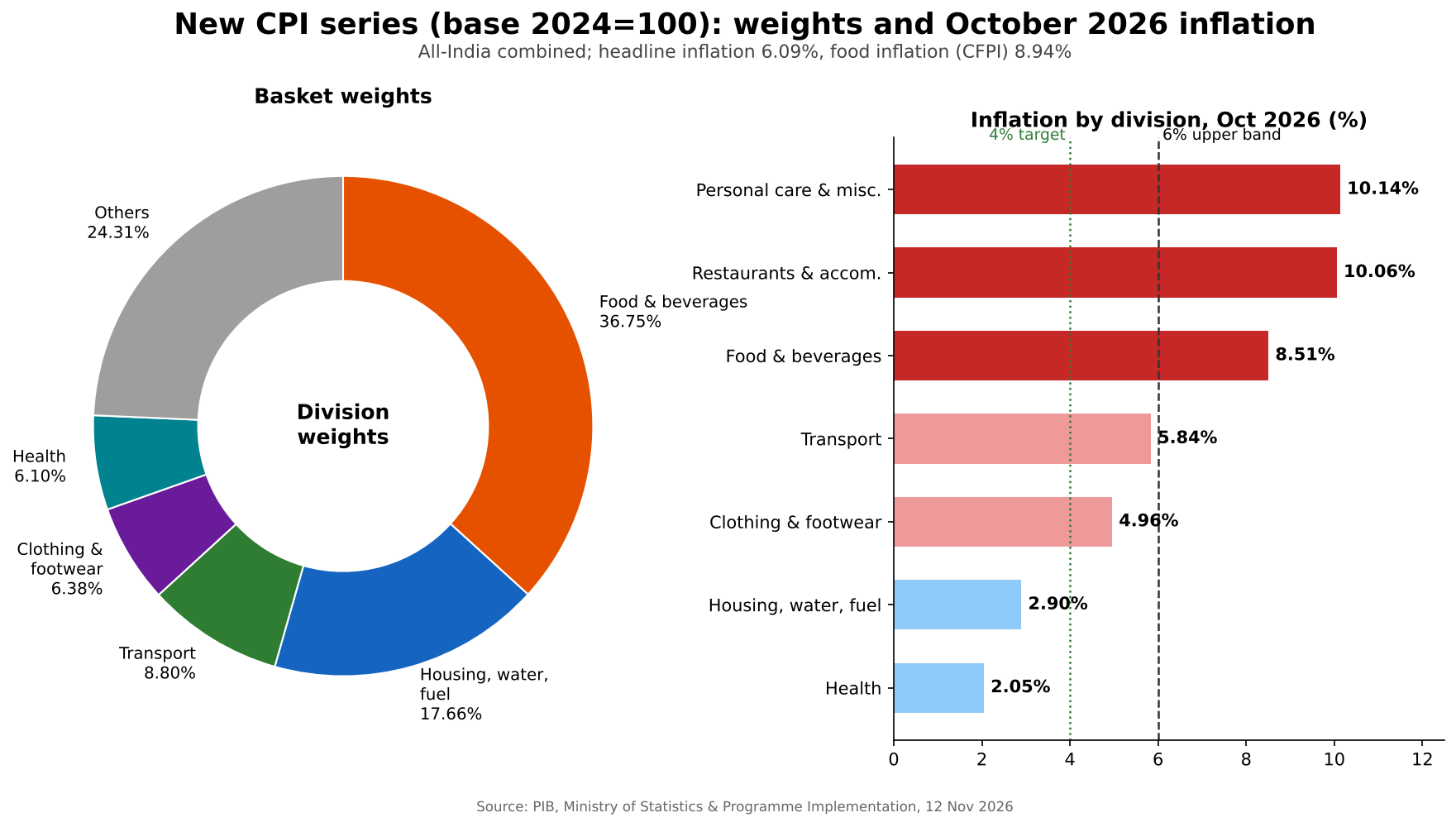
Fastest-rising divisions: personal care and miscellaneous goods (10.14%, driven by "other personal effects" such as jewellery at 25.44%) and restaurants and accommodation (10.06%).
Prices are collected weekly by the Field Operations Division of the NSO from 1,407 urban markets (including online markets) and 1,465 villages. The response rate was 100%.
The CPI for November 2026 will be released on 14 December 2026. State and item indices are on MoSPI's eSankhyiki portal.
Prelims Facts & Static Linkages
Key features of the new CPI series
Base year 2024=100, replacing the old 2012=100 series. A newer base captures today's consumption basket.
Classification: items are grouped into divisions that follow the UN's COICOP 2018 (Classification of Individual Consumption According to Purpose). The new list includes divisions such as "Information and communication" and "Restaurants and accommodation services".
Weight of food and beverages:36.75% of the basket, the largest division. Housing, water, electricity, gas and fuels come next at 17.66%.
Three indices: rural, urban and combined. The combined CPI is the one used for inflation targeting.
Online markets are now part of urban price collection, reflecting e-commerce.
Division weights and inflation (combined, October 2026)
Division
Weight (%)
Inflation (%)
Food and beverages
36.75
8.51
Housing, water, electricity, gas and fuels
17.66
2.90
Transport
8.80
5.84
Clothing and footwear
6.38
4.96
Health
6.10
2.05
Restaurants and accommodation
3.35
10.06
Inflation targeting in India
The RBI Act, 1934 (amended in 2016) set up flexible inflation targeting and a six-member Monetary Policy Committee (MPC).
The Government sets the target in consultation with the RBI: 4% CPI (combined) inflation, with a band of 2% to 6%.
October's 6.09% is just above the upper tolerance limit of 6%.
Food inflation is driven by supply shocks (weather, crop damage), which the repo rate cannot fix directly. Hence buffer stocks, export curbs and price stabilisation funds matter.
CPI versus WPI
Feature
CPI
WPI
Compiled by
NSO, MoSPI
Office of the Economic Adviser, DPIIT
Prices
Retail
Wholesale (first point of bulk sale)
Services
Included
Not included
Weight of food
Higher
Lower
Used for
RBI inflation target
Deflating some output series
Likely Prelims angles
Base year and compiling agency of CPI versus WPI.
The inflation target and its tolerance band.
Why core inflation differs from headline inflation.
Quick Revision
October 2026 CPI inflation (base 2024): 6.09%; food inflation: 8.94%.
Rural inflation (6.63%) was higher than urban (5.41%).
Onion inflation was 116.22%; potato was in deflation at -14.24%.
Food and beverages carry a 36.75% weight in the new CPI.
The inflation target is 4% ± 2% on CPI (combined).
The NSO collects prices from 1,407 urban markets and 1,465 villages.
Practice MCQ
Q. With reference to the Consumer Price Index (CPI) on base 2024=100, consider the following statements:
1. It is compiled by the Office of the Economic Adviser in the Department for Promotion of Industry and Internal Trade.
2. Food and beverages have the largest weight among its divisions.
3. Its urban price collection includes online markets.
Which of the statements given above is/are correct?
(a) 1 and 2 only
(b) 2 and 3 only
(c) 3 only
(d) 1, 2 and 3
Answer: (b). CPI is compiled by the NSO under MoSPI. The Office of the Economic Adviser compiles the WPI.
Related PYQs
PYQ 1 (UPSC CSE Prelims 2020)
Consider the following statements:
1. The weightage of food in Consumer Price Index (CPI) is higher than that in Wholesale Price Index (WPI).
2. The WPI does not capture changes in the prices of services, which CPI does.
3. Reserve Bank of India has now adopted WPI as its key measure of inflation and to decide on changing the key policy rates.
Which of the statements given above is/are correct?



 28
Nov 2026
 28
Nov 2026
 28
Nov 2026














0 comments
Discussion
No comments yet. Be the first.