High-Level Event on the Second Global Stocktake (GST-2) at UNFCCC COP31 in Antalya, Türkiye, on 18 November 2026
DDecode Civils
· 4 min read
Second Global Stocktake under the Paris Agreement
Why in News
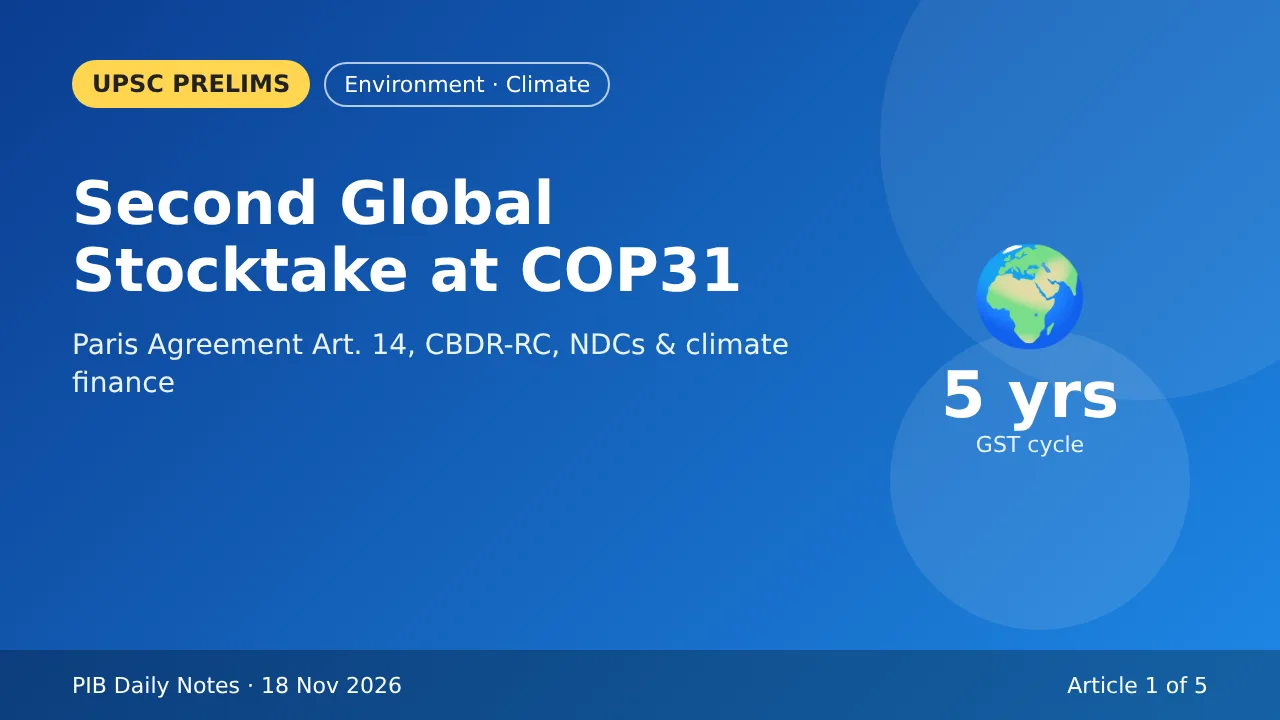
At the High-Level Event on the Second Global Stocktake (GST-2) at UNFCCC COP31 in Antalya, Türkiye, on 18 November 2026, Union Environment Minister Bhupender Yadav called for GST-2 to be an open, transparent and inclusive process, grounded in the best available science and equity.
News Summary
India said the GST must take a 360-degree view of the Paris Agreement and record both achievements and gaps.
The process must follow equity and Common but Differentiated Responsibilities and Respective Capabilities (CBDR-RC), with developed countries taking the lead.
Scientific reports from developing countries should be recognised alongside IPCC reports.
GST-2 should examine why the world is still at risk of crossing the 1.5°C threshold despite progress.
India said delivery of climate finance and technology transfer has fallen far below the obligations of developed countries, and asked for solution-oriented outcomes that guide the next round of NDCs.
Prelims Facts & Static Linkages
What the Global Stocktake is
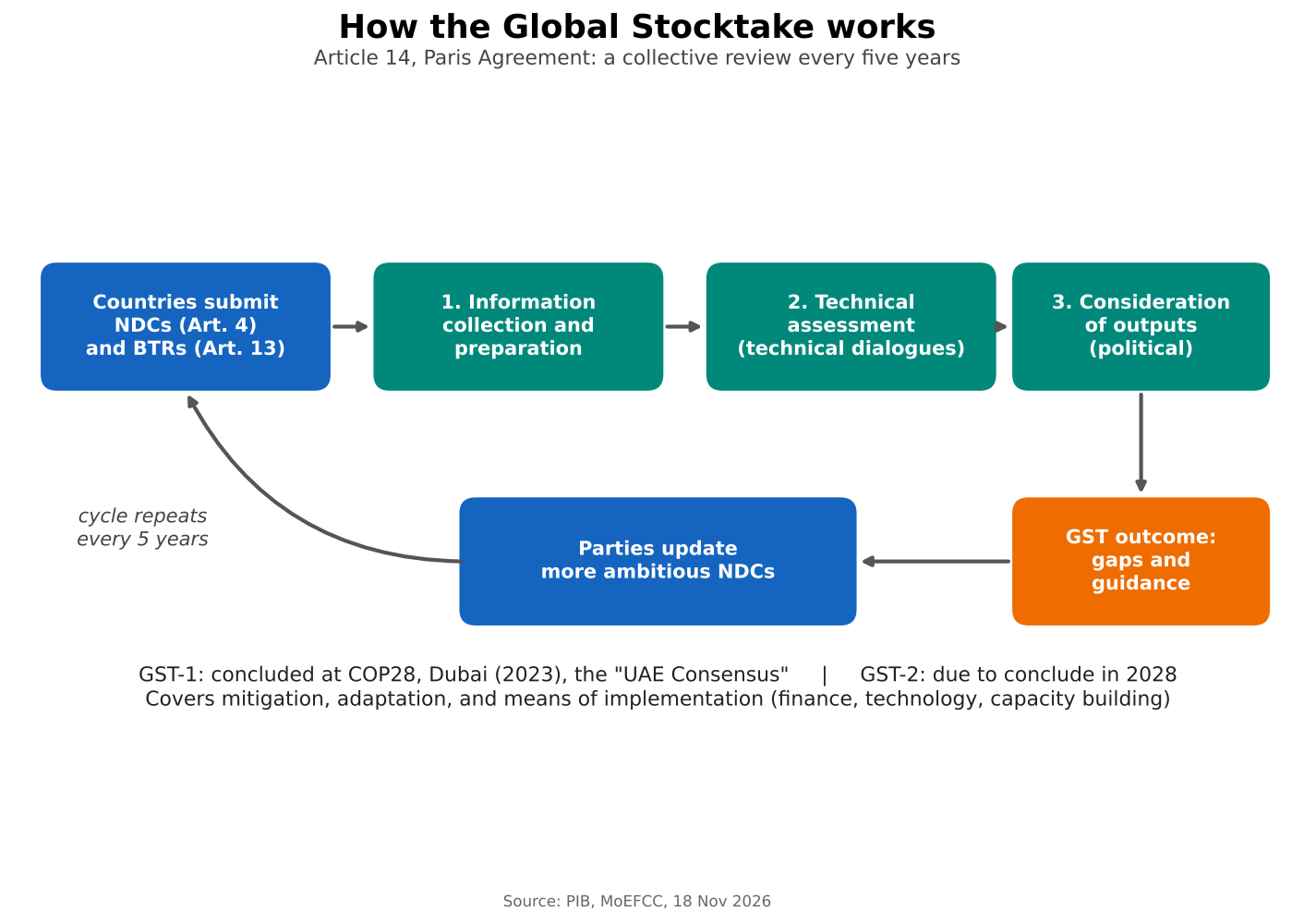
The GST is set out in Article 14 of the Paris Agreement (2015).
It assesses collective progress towards the Agreement's long-term goals. It does not judge any single country.
It is held every five years. The first GST concluded at COP28 in Dubai (2023) with the "UAE Consensus".
The first GST called for tripling global renewable capacity and doubling energy efficiency by 2030, and for "transitioning away from fossil fuels in energy systems".
GST-2 is due to conclude in 2028, and its outcome feeds the NDCs due in 2030.
Each GST has three components:
Information collection and preparation
Technical assessment, through technical dialogues
Consideration of outputs, at the political level
Key Articles of the Paris Agreement
Article
Subject
Article 2
Hold warming well below 2°C and pursue efforts to limit it to 1.5°C
Climate finance from developed to developing countries
Article 13
Enhanced Transparency Framework, under which Parties file BTRs
Article 14
Global Stocktake
Related terms
CBDR-RC: a principle from the UNFCCC (1992). All countries share responsibility for climate change, but their duties differ by historical emissions and capability.
COP: the Conference of the Parties, the UNFCCC's supreme body, which meets every year.
IPCC: the Intergovernmental Panel on Climate Change, set up in 1988 by WMO and UNEP. It assesses climate science but does not do its own research.
India's updated NDC (2022):
Cut the emissions intensity of GDP by 45% from 2005 levels by 2030.
Reach about 50% of installed power capacity from non-fossil sources by 2030.
India's long-term goal is net zero by 2070.
Quick Revision
The Global Stocktake is under Article 14 of the Paris Agreement.
A GST is held every five years. The first concluded at COP28 in Dubai in 2023.
COP31 is being held in Antalya, Türkiye.
Article 6 deals with carbon markets and non-market approaches.
CBDR-RC comes from the UNFCCC of 1992.
The IPCC was set up by WMO and UNEP in 1988.
India's net-zero target year is 2070.
Practice MCQ
Q. With reference to the Global Stocktake under the Paris Agreement, consider the following statements:
1. It is conducted every five years.
2. It assesses the progress of each country individually against its NDC.
3. The first Global Stocktake concluded at COP28 in Dubai.
Which of the statements given above are correct?
(a) 1 and 2 only
(b) 1 and 3 only
(c) 2 and 3 only
(d) 1, 2 and 3
Answer: (b). The GST assesses collective, not individual, progress.
Related PYQs
PYQ 1 (UPSC CSE Prelims 2025)
Consider the following statements:
Statement I: Article 6 of the Paris Agreement on climate change is frequently discussed in global discussions on sustainable development and climate change.
Statement II: Article 6 of the Paris Agreement on climate change sets out the principles of carbon markets.
Statement III: Article 6 of the Paris Agreement on climate change intends to promote inter-country non-market strategies to reach their climate targets.
Which one of the following is correct in respect of the above statements?
(a) Both Statement II and Statement III are correct and both of them explain Statement I
(b) Both Statement II and Statement III are correct but only one of them explains Statement I
(c) Only one of the Statements II and III is correct and that explains Statement I
(d) Neither Statement II nor Statement III is correct



 24
Nov 2026
 24
Nov 2026
 24
Nov 2026














0 comments
Discussion
No comments yet. Be the first.