
UPSC 2027 eligibility criteria, age limits & number of attempts
The following explanation is based on the Civil Services Examination Rules, 2026, notified by the Department of Personnel and Training (DoPT) on 4 February 2026, and the UPSC's official examination information.
The Union Public Service Commission (UPSC) conducts the Civil Services Examination (CSE) to recruit candidates for prestigious services such as the Indian Administrative Service (IAS), Indian Police Service (IPS), Indian Foreign Service (IFS), Indian Revenue Service (IRS) and other Central Civil Services.
Before beginning preparation for UPSC CSE 2027, aspirants must understand the eligibility conditions, particularly educational qualifications, nationality, age limits, category-wise relaxations and the maximum number of attempts.
The following explanation is based on the Civil Services Examination Rules, 2026, notified by the Department of Personnel and Training (DoPT) on 4 February 2026, and the UPSC's official examination information. The 2027 examination notification will be the final authority for that examination.
1. Nationality
The nationality requirement differs depending on the service.
IAS, IPS and Indian Foreign Service: The candidate must be a citizen of India.
Other services: Candidates may be Indian citizens, subjects of Nepal or Bhutan, certain Tibetan refugees who arrived in India before 1 January 1962, or persons of Indian origin who migrated from specified countries with the intention of permanently settling in India.
Candidates falling under the non-Indian categories must fulfil the prescribed Government of India certificate-of-eligibility requirements. They may be admitted provisionally, but appointment is subject to the necessary certificate.
2. Age Limit
For CSE 2026, the minimum age is 21 years, while the maximum age is 32 years for General and EWS candidates.
The age is calculated as on 1 August of the examination year.
For CSE 2026, candidates must have been born:
Not earlier than 2 August 1994.
Not later than 1 August 2005.
The corresponding date-of-birth cut-off for CSE 2027 must be checked in its official notification.
Category-wise upper age limit
Category | Maximum age |
|---|---|
General | 32 years |
EWS | 32 years |
OBC (Non-Creamy Layer) | 35 years |
SC/ST | 37 years |
PwBD – General/EWS | 42 years |
PwBD – OBC | 45 years |
PwBD – SC/ST | 47 years |
These limits reflect the applicable category-wise relaxations under the 2026 rules.
Other age relaxations
Defence personnel disabled during operations against a foreign country or in a disturbed area and released as a consequence may receive up to three years' relaxation.
Eligible ex-servicemen, including specified commissioned officers, may receive up to five years' relaxation, subject to prescribed service conditions.
Eligible Emergency Commissioned Officers and Short Service Commissioned Officers may also receive up to five years' relaxation under specified conditions.
SC/ST and OBC candidates who also qualify under certain other relaxation categories may receive cumulative age relaxation as permitted by the rules.
Decode Civils Free-for-all Initiatives & Study Material: This is a free-for-all course and provides exam-oriented strategies, analysis and resources for UPSC CSE 2027 & 2028 Aspirants. Click Here to Enroll for Free to Access the Same.
For easy access, the free-for-all material is segregated into 3 folders:
- Prelims: Booklist, 13 Types of MCQs, CSAT High Focus Areas, Polity High Focus Areas.
- Mains: Micro Topic Breakdown, Topic wise PYQ Segregation, Solved PYQs, PDFs of Mudit Sir's Books.
- Current Affairs: May-August Prelims + Mains Notes.
Strategies and Notes can be downloaded for free from relevant folder!
Click Here to Learn More About Decode Civils' UPSC Prelims 2027 Courses
3. Educational Qualification
A candidate must possess a graduate degree from a recognised university or an equivalent qualification recognised under the prescribed rules.
Important provisions:
Candidates from any academic discipline are eligible, including Engineering, Medicine, Commerce, Arts, Science and Management.
There is no minimum percentage requirement in graduation.
Final-year graduation students and candidates awaiting their qualifying examination results may apply for the Preliminary Examination provisionally.
Such candidates must produce valid proof of having passed the qualifying examination within the prescribed deadline, applicable at the Mains stage.
Candidates possessing recognised professional or technical qualifications equivalent to a degree are also eligible.
Therefore, graduation in a particular subject is not mandatory for becoming an IAS, IPS or other civil servant.
4. Number of Attempts
The number of attempts depends on the candidate's category.
Category | Maximum attempts |
|---|---|
General | 6 |
EWS | 6 |
OBC | 9 |
SC/ST | Unlimited |
PwBD – General/EWS/OBC | 9 |
PwBD – SC/ST | Unlimited |
Important rules regarding attempts:
An attempt is counted only when a candidate actually appears in at least one paper of the Preliminary Examination.
Merely submitting the application form does not count as an attempt.
If a candidate appears in Prelims but subsequently gets disqualified, the attempt is still counted.
There is no restriction on the number of attempts for eligible SC/ST candidates, subject to the applicable age limit and other eligibility conditions.
These provisions are confirmed by UPSC's official FAQ and the 2026 examination rules.
5. Latest Policy Changes: Important for CSE 2027 Aspirants
The Civil Services Examination Rules, 2026 introduced specific provisions concerning candidates who have already received service allocation but wish to appear again.
Candidates allocated IPS or a Central Group A service through CSE 2026 can get a one-time opportunity to appear in CSE 2027, subject to training-related conditions and other eligibility requirements.
Candidates allocated services through CSE 2025 or earlier have been provided a one-time opportunity to appear in either CSE 2026 or CSE 2027 without resigning from their allocated service.
For subsequent examinations from CSE 2028 onwards, candidates wishing to reappear after service allocation must resign from their allocated service, subject to the applicable rules.
Candidates already appointed to IAS or IFS and continuing as members of those services face separate restrictions on appearing in subsequent examinations.
These provisions are particularly relevant to serving candidates and repeat aspirants, rather than fresh candidates.
6. Important Documents and Conditions
Candidates should keep the following documents ready:
Matriculation certificate for date-of-birth verification.
Graduation degree or qualifying examination documents.
Valid category certificate, wherever applicable.
PwBD certificate, wherever applicable.
Nationality-related eligibility certificate, wherever required.
UPSC accepts the date of birth recorded in the prescribed matriculation or equivalent certificate. Subsequent requests for changing the recorded date of birth are not entertained.
Conclusion
UPSC CSE is open to graduates from diverse academic backgrounds, provided they satisfy the prescribed nationality, age and attempt requirements. Before starting preparation, aspirants should verify their eligibility rather than relying on assumptions or outdated information.
For CSE 2027, always refer to the official notification when released, since the 2026 rules provide the latest available reference but do not automatically establish every examination-specific condition for 2027.
Decode Civils Free-for-all Initiatives & Study Material: This is a free-for-all course and provides exam-oriented strategies, analysis and resources for UPSC CSE 2027 & 2028 Aspirants. Click Here to Enroll for Free to Access the Same.
For easy access, the free-for-all material is segregated into 3 folders:
- Prelims: Booklist, 13 Types of MCQs, CSAT High Focus Areas, Polity High Focus Areas.
- Mains: Micro Topic Breakdown, Topic wise PYQ Segregation, Solved PYQs, PDFs of Mudit Sir's Books.
- Current Affairs: May-August Prelims + Mains Notes.
Strategies and Notes can be downloaded for free from relevant folder!
Click Here to Learn More About Decode Civils' UPSC Prelims 2027 Courses
Downloads
Most read on Mudit Jain Blogs
- 2026 UPSC CSE Prelims GS Detailed Analysis Analysis
- Booklist & Sources for UPSC Prelims 2027 Prelims
- UPSC Prelims - Types of Questions Asked 2013 Onwards Analysis
- 2026 UPSC CSE Prelims CSAT Detailed Analysis Analysis
- 2013-2025 UPSC Mains GS-2 PYQs Analysis Analysis
- K.N.Chandana Jahnavi (CSE-23 AIR-50) Comprehensive and Sociology Strategy Topper Strategies
- 2013-2025 UPSC Mains GS-1 PYQs Analysis Analysis
- Prajnanandan Giri (CSE-23 AIR-24) Journey, Geography & Comprehensive Strategy Topper Strategies
- Aditi Varshney (AIR-57 CSE-22) Comprehensive Strategy Topper Strategies
- Jatin Jain (AIR-91 CSE-22) Sociology + Comprehensive Strategy Topper Strategies
Preparing for UPSC?
Talk to us about the right programme for your attempt.
Keep reading
Related articles
 19
Nov 2026
Foundation · Prelims
How to Use UPSC PYQs Effectively?
Sourabh Arbole Sir, who has cleared all six of his UPSC Prelims attempts, advocates a deeper approach. His methodology focuses on understanding how UPSC
Decode Civils · 19 Nov 2026
 19
Nov 2026
Foundation · Prelims
Newspaper and Current Affairs Strategy for UPSC Beginners: Mudit Jain (Ex-IPS, Ex-IRS)
Mudit Jain (Ex-IPS, Ex-IRS), who cleared UPSC CSE three times with AIR 222, 207 and 173, emphasises comprehensive coverage, linking Current Affairs with static subjects, systematic revision and question-based practice.
Decode Civils · 19 Nov 2026
 18
Nov 2026
Foundation · Prelims
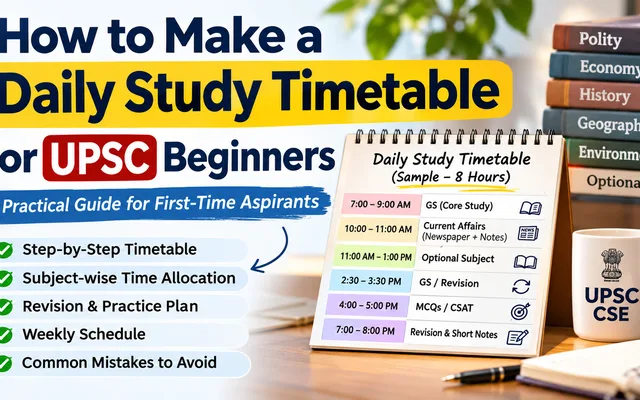
How to Make a Daily Study Timetable for UPSC Beginners?
A well-structured UPSC daily study timetable helps aspirants maintain consistency, complete the syllabus and develop effective revision habits. However, the objective is not to study for 12–14 hours daily but to make every study session productive.
Decode Civils · 18 Nov 2026
Our programmes
Courses for your attempt
History Module For Prelims 2027
The toughest part of Prelims, simplified by someone who has cleared Prelims 7 out of 7 times.
History Starts 20 Dec 2026
₹2,359 ₹2,949
Learn More: History Module For Prelims 2027
Current Affairs For Prelims 2027 (Plus)
The only current affairs course with direct hits in UPSC Prelims
CA Plus Starts 4 Jan 2027
₹4,129 ₹4,719
Learn More: Current Affairs For Prelims 2027 (Plus)
Current Affairs For Prelims 2027 (Base)
The only current affairs course with direct hits in UPSC Prelims
CA Base Starts 4 Jan 2027
₹3,539 ₹4,129
Learn More: Current Affairs For Prelims 2027 (Base)
PYQ Edge
A PYQ mastery program: use PYQs to build an edge in your Prelims score
PYQ Edge Starts 15 Dec 2026
₹2,359 ₹2,949
Learn More: PYQ Edge
Prelims Excellence Program 2027 (Pro)
Your One Stop Solution For Prelims 2027
PEP Pro Starts 20 Nov 2026
₹20,059 ₹22,419
Learn More: Prelims Excellence Program 2027 (Pro)
Prelims Excellence Program 2027 (Plus)
Your One Stop Solution For Prelims 2027
PEP Plus Starts 20 Nov 2026
₹11,799 10618.82
Learn More: Prelims Excellence Program 2027 (Plus)
Prelims Excellence Program 2027 (Base)
Your One Stop Solution For Prelims 2027
PEP Base Starts 20 Nov 2026
₹7,079 ₹8,259
Learn More: Prelims Excellence Program 2027 (Base)
CSAT Enrichment Batch
Master the art and science of solving CSAT
₹2,359 ₹2,949
Learn More: CSAT Enrichment Batch
CSAT WEEKEND BATCH
Master CSAT for UPSC Prelims 2027 with expert guidance, focused practice, and mock tests.
CSAT WEEKEND BATCH Starts 31 Oct 2026
₹5,899 ₹8,259
Learn More: CSAT WEEKEND BATCH
ANTHROPOLOGY THROUGH PYQ's
Understand what UPSC asks and how to answer it from the Anthro Topper.
₹5,899 ₹8,259
Learn More: ANTHROPOLOGY THROUGH PYQ's
PSIR EXCELLENCE PROGRAM PRO (OFFLINE): Batch-2
An Enrichment Course that can help you add 50+ marks in your PSIR Scores.
PSIR EXCELLENCE PROGRAM PRO (ONLINE): Batch-2
An Enrichment Course that can help you add 50+ marks in your PSIR Scores.
0 comments
Discussion
No comments yet. Be the first.