
UPSC Prelims Syllabus and Exam Pattern? (2027 Guide)
An analysis of the last five examinations (2022–2026) reveals that UPSC increasingly emphasises conceptual clarity, statement-based questions and the integration of static subjects with current developments.
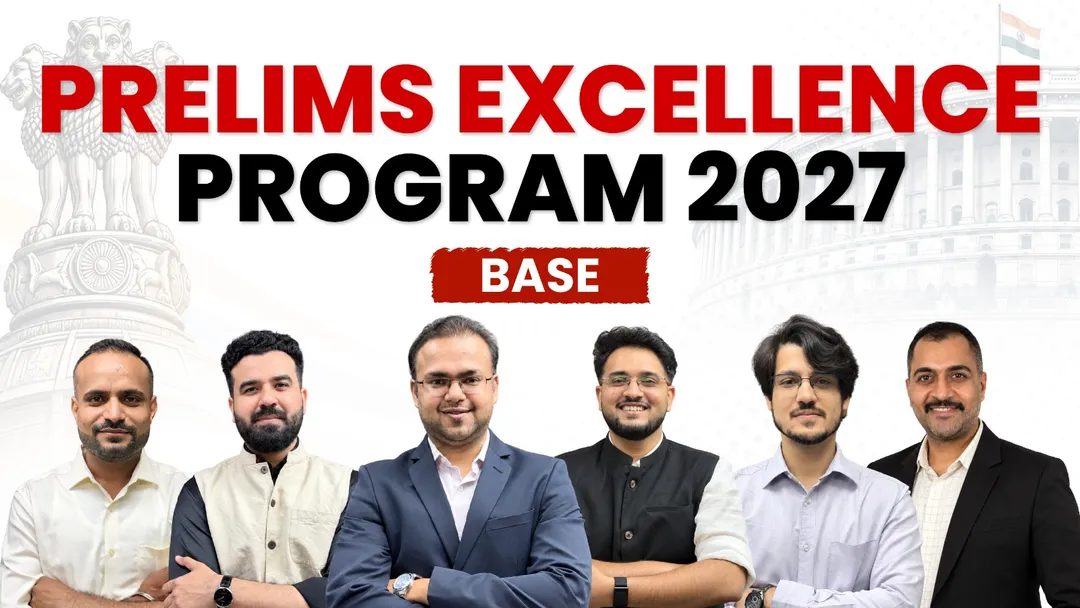

The UPSC Civil Services Preliminary Examination (Prelims) is the first stage of the selection process for prestigious services such as IAS, IPS, IFS and IRS. It tests candidates' conceptual understanding, analytical ability, awareness of current affairs and decision-making under uncertainty.
An analysis of the last five examinations (2022–2026) reveals that UPSC increasingly emphasises conceptual clarity, statement-based questions and the integration of static subjects with current developments.
1. UPSC Prelims Exam Pattern
The examination consists of two compulsory objective-type papers conducted on the same day.
| Particulars | GS Paper I | GS Paper II (CSAT) |
|---|---|---|
| Questions | 100 | 80 |
| Maximum marks | 200 | 200 |
| Duration | 2 hours | 2 hours |
| Marks per question | 2 | 2.5 |
| Negative marking | 0.66 | 0.83 |
| Nature | Merit-based | Qualifying |
| Qualifying marks | Cut-off varies | 33% (66.67 marks) |
Both papers are compulsory. Only GS Paper I determines the Prelims merit cut-off, provided the candidate qualifies in CSAT. Prelims marks are not counted towards the final selection.
2. Complete UPSC Prelims GS Paper I Syllabus
The official syllabus covers seven broad areas:
Current Events: National and international developments, government schemes, international organisations, reports and indices.
History of India and Indian National Movement: Ancient, Medieval and Modern Indian History, freedom struggle, art and culture.
Indian and World Geography: Physical, social and economic geography, climate, resources, agriculture and mapping.
Indian Polity and Governance: Constitution, political system, Panchayati Raj, public policy, rights issues and governance.
Economic and Social Development: Sustainable development, poverty, inclusion, demographics and social-sector initiatives.
Environmental Ecology, Biodiversity and Climate Change: Ecosystems, conservation, protected areas, environmental conventions and climate change.
General Science: Fundamental scientific principles and developments in biotechnology, space, defence and emerging technologies.
Decode Civils Free-for-all Initiatives & Study Material: This is a free-for-all course and provides exam-oriented strategies, analysis and resources for UPSC CSE 2027 & 2028 Aspirants. Click Here to Enroll for Free to Access the Same.
For easy access, the free-for-all material is segregated into 3 folders:
- Prelims: Booklist, 13 Types of MCQs, CSAT High Focus Areas, Polity High Focus Areas.
- Mains: Micro Topic Breakdown, Topic wise PYQ Segregation, Solved PYQs, PDFs of Mudit Sir's Books.
- Current Affairs: May-August Prelims + Mains Notes.
Strategies and Notes can be downloaded for free from relevant folder!
Click Here to Learn More About Decode Civils' UPSC Prelims 2027 Courses
3. Complete UPSC CSAT Syllabus
General Studies Paper II assesses:
Comprehension
Interpersonal and communication skills
Logical reasoning and analytical ability
Decision-making and problem-solving
General mental ability
Basic numeracy (Class X level)
Data interpretation (Class X level)
Although CSAT is qualifying, aspirants must not neglect it. Regular comprehension, reasoning and mathematics practice is essential.
4. UPSC Prelims Trends: Last Five Years (2022–2026)
The following table presents approximate annual averages based on one classification of the previous five papers. Subject categorisation is analytical, not officially prescribed by UPSC.
| Subject | Average questions per year |
|---|---|
| Economy | 18 |
| Science & Technology | 15 |
| Polity | 14 |
| Environment | 13 |
| Geography | 12 |
| History & Culture | 11 |
| International Relations | 10 |
| Other / Current Affairs | 7 |
Rounded estimates derived from the 2022–2026 question classifications.
Five Important Trends
1. Statement-based questions dominate: UPSC increasingly tests whether candidates can independently evaluate multiple statements rather than merely recall facts.
2. Economy remains consistently important: Banking, monetary policy, inflation, fiscal policy and economic concepts repeatedly feature in the examination.
3. Current affairs require conceptual understanding: Recent developments are frequently connected with foundational knowledge of polity, economy, science and environment.
4. Question formats are evolving: Matching, statement combinations and assertion-style questions require careful reading and elimination techniques.
5. Subject weightage fluctuates: Geography, history, polity and environment show significant annual variation. Ignoring any major subject is therefore risky.
5. How Should Beginners Prepare for UPSC Prelims 2027?
Begin with NCERTs, followed by standard reference books. Study the official syllabus alongside previous-year questions (PYQs).
Prioritise conceptual understanding, connect current affairs with static topics and revise regularly. Practise topic-wise MCQs before progressing to full-length mock tests.
For CSAT, identify weaknesses early and practise consistently instead of postponing preparation until the final months.
Quantitative Aptitude features challenging questions on number systems, percentages, ratios, time and work, and mathematical reasoning. Reading Comprehension demands careful interpretation, inference and identification of central arguments. Logical Reasoning emphasises analytical puzzles, arrangements and deduction.
Conclusion
UPSC Prelims is no longer merely a test of factual knowledge. The 2022–2026 papers demonstrate the importance of conceptual clarity, analytical thinking, intelligent elimination and balanced preparation.
For UPSC CSE 2027, the most effective strategy is to complete the syllabus comprehensively, analyse PYQs and strengthen accuracy through systematic revision and mock-test practice.
Decode Civils Free-for-all Initiatives & Study Material: This is a free-for-all course and provides exam-oriented strategies, analysis and resources for UPSC CSE 2027 & 2028 Aspirants. Click Here to Enroll for Free to Access the Same.
For easy access, the free-for-all material is segregated into 3 folders:
- Prelims: Booklist, 13 Types of MCQs, CSAT High Focus Areas, Polity High Focus Areas.
- Mains: Micro Topic Breakdown, Topic wise PYQ Segregation, Solved PYQs, PDFs of Mudit Sir's Books.
- Current Affairs: May-August Prelims + Mains Notes.
Strategies and Notes can be downloaded for free from relevant folder!
Click Here to Learn More About Decode Civils' UPSC Prelims 2027 Courses
Downloads
Most read on Mudit Jain Blogs
- 2026 UPSC CSE Prelims GS Detailed Analysis Analysis
- Booklist & Sources for UPSC Prelims 2027 Prelims
- UPSC Prelims - Types of Questions Asked 2013 Onwards Analysis
- 2026 UPSC CSE Prelims CSAT Detailed Analysis Analysis
- 2013-2025 UPSC Mains GS-2 PYQs Analysis Analysis
- K.N.Chandana Jahnavi (CSE-23 AIR-50) Comprehensive and Sociology Strategy Topper Strategies
- 2013-2025 UPSC Mains GS-1 PYQs Analysis Analysis
- Prajnanandan Giri (CSE-23 AIR-24) Journey, Geography & Comprehensive Strategy Topper Strategies
- Aditi Varshney (AIR-57 CSE-22) Comprehensive Strategy Topper Strategies
- Jatin Jain (AIR-91 CSE-22) Sociology + Comprehensive Strategy Topper Strategies
Preparing for UPSC?
Talk to us about the right programme for your attempt.
Keep reading
Related articles
 19
Nov 2026
Foundation · Prelims
How to Use UPSC PYQs Effectively?
Sourabh Arbole Sir, who has cleared all six of his UPSC Prelims attempts, advocates a deeper approach. His methodology focuses on understanding how UPSC
Decode Civils · 19 Nov 2026
 19
Nov 2026
Foundation · Prelims
Newspaper and Current Affairs Strategy for UPSC Beginners: Mudit Jain (Ex-IPS, Ex-IRS)
Mudit Jain (Ex-IPS, Ex-IRS), who cleared UPSC CSE three times with AIR 222, 207 and 173, emphasises comprehensive coverage, linking Current Affairs with static subjects, systematic revision and question-based practice.
Decode Civils · 19 Nov 2026
 18
Nov 2026
Foundation · Prelims
How to Make a Daily Study Timetable for UPSC Beginners?
A well-structured UPSC daily study timetable helps aspirants maintain consistency, complete the syllabus and develop effective revision habits. However, the objective is not to study for 12–14 hours daily but to make every study session productive.
Decode Civils · 18 Nov 2026
Our programmes
Courses for your attempt

History Module For Prelims 2027
The toughest part of Prelims, simplified by someone who has cleared Prelims 7 out of 7 times.
History Starts 20 Dec 2026
₹2,359 ₹2,949
Learn More: History Module For Prelims 2027
Current Affairs For Prelims 2027 (Plus)
The only current affairs course with direct hits in UPSC Prelims
CA Plus Starts 4 Jan 2027
₹4,129 ₹4,719
Learn More: Current Affairs For Prelims 2027 (Plus)
Current Affairs For Prelims 2027 (Base)
The only current affairs course with direct hits in UPSC Prelims
CA Base Starts 4 Jan 2027
₹3,539 ₹4,129
Learn More: Current Affairs For Prelims 2027 (Base)
PYQ Edge
A PYQ mastery program: use PYQs to build an edge in your Prelims score
PYQ Edge Starts 15 Dec 2026
₹2,359 ₹2,949
Learn More: PYQ Edge
Prelims Excellence Program 2027 (Pro)
Your One Stop Solution For Prelims 2027
PEP Pro Starts 20 Nov 2026
₹20,059 ₹22,419
Learn More: Prelims Excellence Program 2027 (Pro)
Prelims Excellence Program 2027 (Plus)
Your One Stop Solution For Prelims 2027
PEP Plus Starts 20 Nov 2026
₹11,799 10618.82
Learn More: Prelims Excellence Program 2027 (Plus)
Prelims Excellence Program 2027 (Base)
Your One Stop Solution For Prelims 2027
PEP Base Starts 20 Nov 2026
₹7,079 ₹8,259
Learn More: Prelims Excellence Program 2027 (Base)
CSAT Enrichment Batch
Master the art and science of solving CSAT
₹2,359 ₹2,949
Learn More: CSAT Enrichment Batch
CSAT WEEKEND BATCH
Master CSAT for UPSC Prelims 2027 with expert guidance, focused practice, and mock tests.
CSAT WEEKEND BATCH Starts 31 Oct 2026
₹5,899 ₹8,259
Learn More: CSAT WEEKEND BATCH
ANTHROPOLOGY THROUGH PYQ's
Understand what UPSC asks and how to answer it from the Anthro Topper.
₹5,899 ₹8,259
Learn More: ANTHROPOLOGY THROUGH PYQ's
PSIR EXCELLENCE PROGRAM PRO (OFFLINE): Batch-2
An Enrichment Course that can help you add 50+ marks in your PSIR Scores.

PSIR EXCELLENCE PROGRAM PRO (ONLINE): Batch-2
An Enrichment Course that can help you add 50+ marks in your PSIR Scores.


0 comments
Discussion
No comments yet. Be the first.