
Which NCERT Books Are Required for UPSC Prelims?
My recommended approach is to select 19 high-utility NCERT textbooks from Classes 11 and 12, prioritising Geography, Economy, Society, Art & Culture, Environment and Science. Polity and Modern History should receive comparatively less NCERT reading time because standard reference books are generall
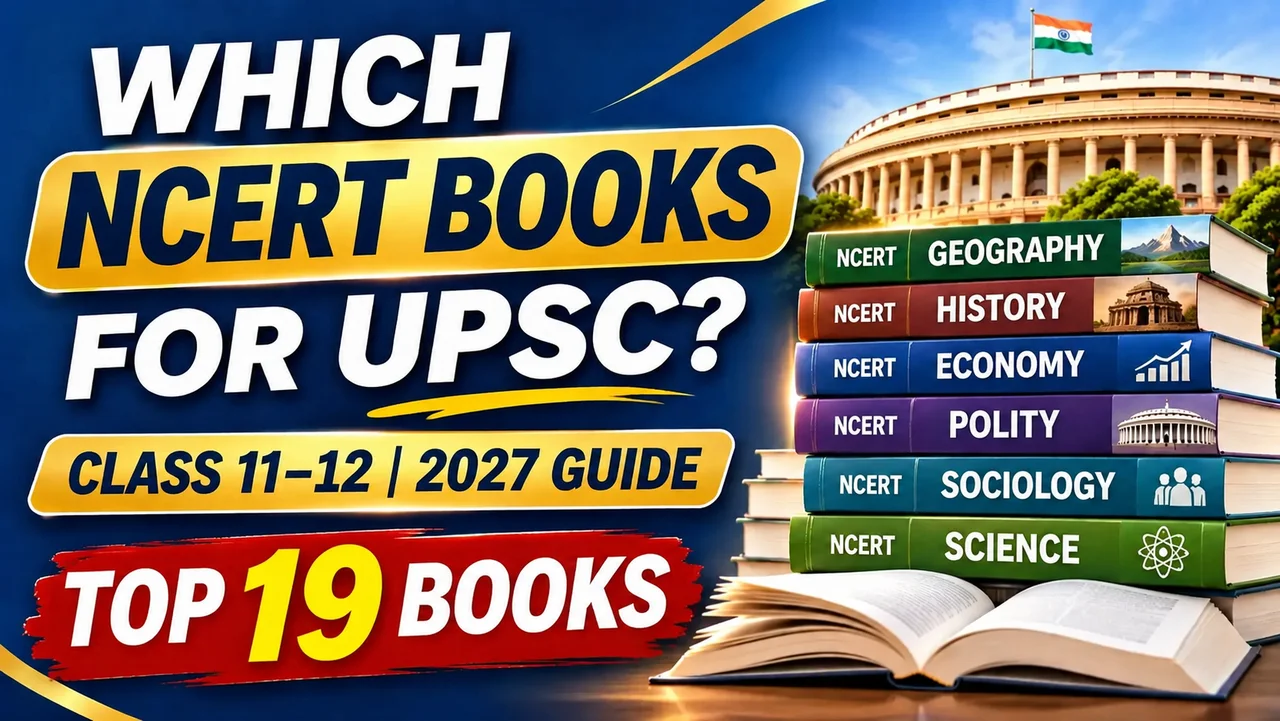
For UPSC Civil Services Examination, selective NCERT reading is more effective than reading every textbook from Classes 6–12.
The objective should be to build conceptual clarity for Prelims and Mains without duplicating content already covered more effectively by standard reference books.
My recommended approach is to select 19 high-utility NCERT textbooks from Classes 11 and 12, prioritising Geography, Economy, Society, Art & Culture, Environment and Science.
Polity and Modern History should receive comparatively less NCERT reading time because standard reference books are generally more exam-oriented.
1. The 19 Essential NCERT Books
The following selection covers the major General Studies subjects while avoiding unnecessary duplication.
No. | NCERT Book | Class | Reading Priority |
|---|---|---|---|
Geography — 4 Books | |||
1 | Fundamentals of Physical Geography | XI | Must Read |
2 | India: Physical Environment | XI | Must Read |
3 | Fundamentals of Human Geography | XII | Must Read |
4 | India: People and Economy | XII | Must Read |
Economy — 2 Books | |||
5 | Indian Economic Development | XI | Must Read |
6 | Introductory Macroeconomics | XII | Must Read |
History & Art and Culture — 4 Books | |||
7 | Themes in Indian History – Part I | XII | Must Read |
8 | Themes in Indian History – Part II | XII | Must Read |
9 | Themes in Indian History – Part III | XII | Selective |
10 | An Introduction to Indian Art – Part I | XI | Must Read |
Polity & International Relations — 3 Books | |||
11 | Indian Constitution at Work | XI | Selective |
12 | Contemporary World Politics | XII | Selective |
13 | Politics in India Since Independence | XII | Selective |
Indian Society — 3 Books | |||
14 | Introducing Sociology | XI | Selective |
15 | Indian Society | XII | Must Read |
16 | Social Change and Development in India | XII | Must Read |
Environment & Science — 3 Books | |||
17 | Biology | XI | Selected Chapters |
18 | Biology | XII | Selected Chapters |
19 | Chemistry – Part II | XII | Selected Chapters |
Ethics — 1 Book | |||
20 | Psychology | XI | Selected Chapters |
2. NCERTs You Can Safely Deprioritise
For a General Studies-focused beginner, these books usually offer a lower return on preparation time:
Class XI Themes in World History: use selective chapters only when needed for GS-I.
Class XI Political Theory: read selected concepts such as liberty, equality, justice and rights if your Ethics or Polity foundation is weak.
Class XI Statistics for Economics and Class XII Introductory Microeconomics: not necessary as complete books for most aspirants.
Full Class XI–XII Physics, Chemistry and Mathematics textbooks: unnecessary for GS preparation.
Class XI Practical Work in Geography: use mapping-related portions only.
Decode Civils Free-for-all Initiatives & Study Material: This is a free-for-all course and provides exam-oriented strategies, analysis and resources for UPSC CSE 2027 & 2028 Aspirants. Click Here to Enroll for Free to Access the Same.
For easy access, the free-for-all material is segregated into 3 folders:
- Prelims: Booklist, 13 Types of MCQs, CSAT High Focus Areas, Polity High Focus Areas.
- Mains: Micro Topic Breakdown, Topic wise PYQ Segregation, Solved PYQs, PDFs of Mudit Sir's Books.
- Current Affairs: May-August Prelims + Mains Notes.
Strategies and Notes can be downloaded for free from relevant folder!
Click Here to Learn More About Decode Civils' UPSC Prelims 2027 Courses
Downloads
Most read on Mudit Jain Blogs
- 2026 UPSC CSE Prelims GS Detailed Analysis Analysis
- Booklist & Sources for UPSC Prelims 2027 Prelims
- UPSC Prelims - Types of Questions Asked 2013 Onwards Analysis
- 2026 UPSC CSE Prelims CSAT Detailed Analysis Analysis
- 2013-2025 UPSC Mains GS-2 PYQs Analysis Analysis
- K.N.Chandana Jahnavi (CSE-23 AIR-50) Comprehensive and Sociology Strategy Topper Strategies
- 2013-2025 UPSC Mains GS-1 PYQs Analysis Analysis
- Prajnanandan Giri (CSE-23 AIR-24) Journey, Geography & Comprehensive Strategy Topper Strategies
- Aditi Varshney (AIR-57 CSE-22) Comprehensive Strategy Topper Strategies
- Jatin Jain (AIR-91 CSE-22) Sociology + Comprehensive Strategy Topper Strategies
Preparing for UPSC?
Talk to us about the right programme for your attempt.
Keep reading
Related articles
 19
Nov 2026
Foundation · Prelims
How to Use UPSC PYQs Effectively?
Sourabh Arbole Sir, who has cleared all six of his UPSC Prelims attempts, advocates a deeper approach. His methodology focuses on understanding how UPSC
Decode Civils · 19 Nov 2026
 19
Nov 2026
Foundation · Prelims
Newspaper and Current Affairs Strategy for UPSC Beginners: Mudit Jain (Ex-IPS, Ex-IRS)
Mudit Jain (Ex-IPS, Ex-IRS), who cleared UPSC CSE three times with AIR 222, 207 and 173, emphasises comprehensive coverage, linking Current Affairs with static subjects, systematic revision and question-based practice.
Decode Civils · 19 Nov 2026
 18
Nov 2026
Foundation · Prelims
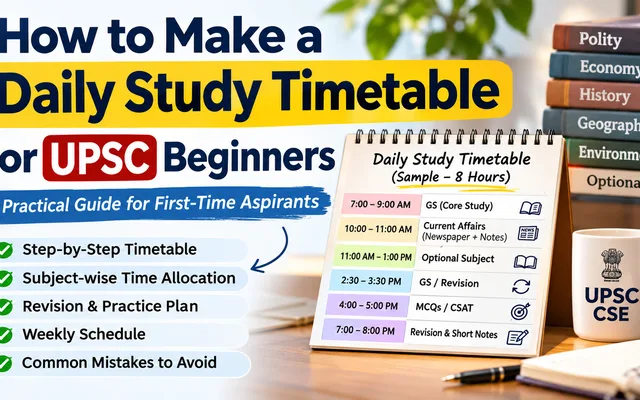
How to Make a Daily Study Timetable for UPSC Beginners?
A well-structured UPSC daily study timetable helps aspirants maintain consistency, complete the syllabus and develop effective revision habits. However, the objective is not to study for 12–14 hours daily but to make every study session productive.
Decode Civils · 18 Nov 2026
Our programmes
Courses for your attempt
History Module For Prelims 2027
The toughest part of Prelims, simplified by someone who has cleared Prelims 7 out of 7 times.
History Starts 20 Dec 2026
₹2,359 ₹2,949
Learn More: History Module For Prelims 2027
Current Affairs For Prelims 2027 (Plus)
The only current affairs course with direct hits in UPSC Prelims
CA Plus Starts 4 Jan 2027
₹4,129 ₹4,719
Learn More: Current Affairs For Prelims 2027 (Plus)
Current Affairs For Prelims 2027 (Base)
The only current affairs course with direct hits in UPSC Prelims
CA Base Starts 4 Jan 2027
₹3,539 ₹4,129
Learn More: Current Affairs For Prelims 2027 (Base)
PYQ Edge
A PYQ mastery program: use PYQs to build an edge in your Prelims score
PYQ Edge Starts 15 Dec 2026
₹2,359 ₹2,949
Learn More: PYQ Edge
Prelims Excellence Program 2027 (Pro)
Your One Stop Solution For Prelims 2027
PEP Pro Starts 20 Nov 2026
₹20,059 ₹22,419
Learn More: Prelims Excellence Program 2027 (Pro)
Prelims Excellence Program 2027 (Plus)
Your One Stop Solution For Prelims 2027
PEP Plus Starts 20 Nov 2026
₹11,799 10618.82
Learn More: Prelims Excellence Program 2027 (Plus)
Prelims Excellence Program 2027 (Base)
Your One Stop Solution For Prelims 2027
PEP Base Starts 20 Nov 2026
₹7,079 ₹8,259
Learn More: Prelims Excellence Program 2027 (Base)
CSAT Enrichment Batch
Master the art and science of solving CSAT
₹2,359 ₹2,949
Learn More: CSAT Enrichment Batch
CSAT WEEKEND BATCH
Master CSAT for UPSC Prelims 2027 with expert guidance, focused practice, and mock tests.
CSAT WEEKEND BATCH Starts 31 Oct 2026
₹5,899 ₹8,259
Learn More: CSAT WEEKEND BATCH
ANTHROPOLOGY THROUGH PYQ's
Understand what UPSC asks and how to answer it from the Anthro Topper.
₹5,899 ₹8,259
Learn More: ANTHROPOLOGY THROUGH PYQ's
PSIR EXCELLENCE PROGRAM PRO (OFFLINE): Batch-2
An Enrichment Course that can help you add 50+ marks in your PSIR Scores.
PSIR EXCELLENCE PROGRAM PRO (ONLINE): Batch-2
An Enrichment Course that can help you add 50+ marks in your PSIR Scores.


0 comments
Discussion
No comments yet. Be the first.