
My Answer Writing Strategy
Answer writing is of course the foundation of CSE MAINS. Once you develop a good answer writing skill, you can be confident of clearing MAINS 10/10 times. My scores in GS: 340 --> 387 --> 426 --> 463. My Strategy involves more than just answer writing. Let’s move in…


Answer writing is of course the foundation of CSE MAINS. Once you develop a good answer writing skill, you can be confident of clearing MAINS 10/10 times.
My scores in GS: 340 --> 387 --> 426 --> 463.
My Strategy involves more than just answer writing.
Let’s move in order:
- Read right material (newspaper must)
- Make notes
- Revise multiple time
- Practice answer writing
One can not jump directly to point 4. Your answer will only be as good as your study material-notes-revision.
Once you know what to write, then only knowing how to write matters.
Answer structure:
- Read the question and break it into subparts. More the subparts better it is.
- Intro
- News background
- Definition/keywords/facts related to question
- Points (in ideal case number of points equal to marks). More the subparts, more the points will be and think time will be less
- Paper specific keywords
- Reports
- Examples
- Diagram
- Conclusion
Breaking a Question into Subparts:
Breaking down a question into parts and subparts is most important if you want to gain 450+ marks in GS. This is the key in writing what UPSC or the examiner actually wants!
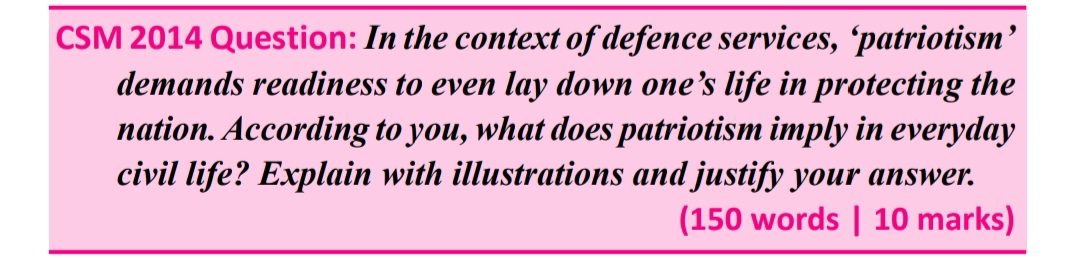
Breaking down includes:
- Read every word of question very carefully.
- Marking parts/sub-questions in a question as you read a question. This saves time.
- Always try to divide question in as many sub parts as possible and make headings for each sub part and address them equally. Then only you would have done justice to the question and would get good marks.
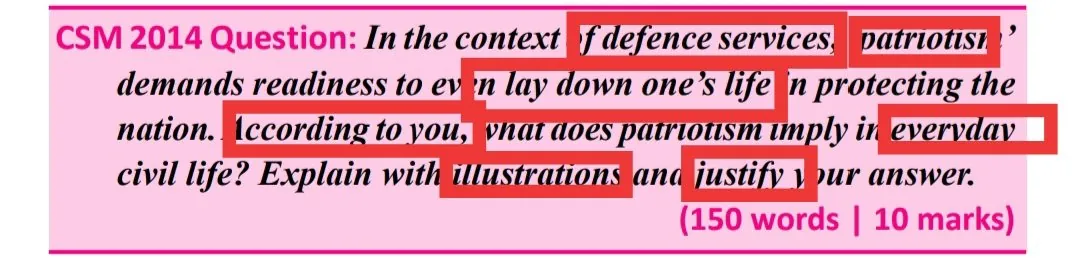
- Higher the sub parts, higher will be the number of points in your answer. This takes care of quantity and will fetch you more marks.
- Breaking down also provides your answer a structure by itself. And a well structured answer fetches higher marks as it takes care of answer quality.
If it is a 15 marks question, I expect 12-15 points. And if 15 marker has 4 subparts, then divide answer accordingly and write 3-4 points for each subpart i.e. 12-15 points overall.
- Hence, dividing question into subparts helps in easily handling the part that you dont know as now you need to write only few points on it.
- If question has a statement and then a question ia asked, the statement becomes 1st part of question! It has to be answered and not ignored like many do.
Example: Pakistan is a rogue state. What are Balakot strikes?
Here question has 2 parts and not 1. You have to answer both parts equally.
- When question asks you to discuss or to analyze/critically analyze etc then clearly divide your answer into positives/pros and negatives/cons. This increases sub-parts and answer content.
- Dividing question into parts would make your answer multi-dimensional. Even if examiner does not like a point or two, he will definitely give you good marks because he simply cannot dislike all 10-12-15 points!
This approach reduces the chances of missing out on what is asked in question, therefore very potent in increasing eventual score.
Question I gave on group: Examine the potential of Indian cooperatives as development partners and analyze the challenges they face along with steps taken by the government towards boosting the role played the cooperatives in development. (250 words, 15 marks)
How many subparts exist for this question? Subparts:
- Potential of Indian cooperatives.
- Challenges.
- Steps taken.
- Role in development.
Apart from the above: Introduction, news background, paper specific keywords, diagram and conclusion / way forward are needed to be written.
Question I gave on group: India’s look west policy has reaped huge rewards in last few years even though certain bilateral-multilateral issues crop up every now and then. What are major effects of Look West policy on indo-pak relations? (200 words, 12.5 marks)
Brainstorm and poll your answer here!
ATB!!!
Preparing for UPSC?
Talk to us about the right programme for your attempt.
Keep reading
Related articles
 24
May 2026
24
May 2026
Mains · Answer Writing Strategies
Diagrams for CSE Mains
Hi all, It is well established fact that answer writing in Mains is all about being unique and innovative. Presentation matters more than we think. Reasons to draw diagrams Break monotony of answers. Uniqueness. Despite knowing that diagrams are needed, not many draw them. To…
Decode Civils · 24 May 2026
 24
May 2026
24
May 2026
Mains · Answer Writing Strategies
Sonali Dev (AIR-41 CSE-21) Strategy
Hi All, Sonali Dev cracked CSE-21 with AIR-41 in her 2nd attempt and she did it while scoring a huge 443 Marks in GS Mains! Following is her Answer Writing Strategy. Hi everyone, this is Sonali Dev. I have secured AIR-41 in UPSC CSE-2021. I am utilizing the platform to write…
Decode Civils · 24 May 2026
 23
May 2026
23
May 2026
Mains · Answer Writing Strategies
When & How To Start Answer Writing Practice?
When To Start? Answer writing is game of both what and how. You must first know what to write and then see how to write. Therefore, you cannot start answer writing till you have not covered fare amount of syllabus. If you start it too early, you won't know what to write and then…
Decode Civils · 23 May 2026
Our programmes
Courses for your attempt

PSIR EXCELLENCE PROGRAM PRO (OFFLINE): Batch-2
An Enrichment Course that can help you add 50+ marks in your PSIR Scores.

PSIR EXCELLENCE PROGRAM PRO (ONLINE): Batch-2
An Enrichment Course that can help you add 50+ marks in your PSIR Scores.

PSIR EXCELLENCE PROGRAM- BASE (OFFLINE): Batch-2
An Enrichment Course that can help you add 50+ marks in your PSIR Scores.
PSIR EXCELLENCE PROGRAM BASE (ONLINE): Batch-2
An Enrichment Course that can help you add 50+ marks in your PSIR Scores.

Mains Excellence Program Pro for Mains 2027 - Final Batch
Your One-Stop Solution for UPSC 2027 Mains: - MEP Faculties have an experience of 22 UPSC CSE Mains, 10 Interviews and 5 Final Selections. - Faculties include Mudit Jain Sir (AIR-222, 207, 173), Sourabh Arbole Sir (6…
Batch 2027 Starts 14 Sep 2026

Mains Excellence Program Plus for Mains 2027 - Final Batch
Your One-Stop Solution for UPSC 2027 Mains: - MEP Faculties have an experience of 22 UPSC CSE Mains, 10 Interviews and 5 Final Selections. - Faculties include Mudit Jain Sir (AIR-222, 207, 173), Sourabh Arbole Sir (6…
Batch 2027 Starts 14 Sep 2026

Mains Excellence Program Basic for Mains 2027 - Final Batch
Your One-Stop Solution for UPSC 2027 Mains: - MEP Faculties have an experience of 22 UPSC CSE Mains, 10 Interviews and 5 Final Selections. - Faculties include Mudit Jain Sir (AIR-222, 207, 173), Sourabh Arbole Sir (6…
Batch 2027 Starts 14 Sep 2026
Foundation + Advanced Ethics Base (Offline)
Is Ethics Paper Doable via Philosophical Gyan or Specific Thematic Preparation is Needed? Last 5 Years' Analysis & 54 Distinct Themes asked by UPSC answer the above question. Thematic preparation and advanced ethics…
Batch 2027 Starts 14 Sep 2026
Foundation + Advanced Ethics Base (Online)
Is Ethics Paper Doable via Philosophical Gyan or Specific Thematic Preparation is Needed? Last 5 Years' Analysis & 54 Distinct Themes asked by UPSC answer the above question. Thematic preparation and advanced ethics…
Batch 2027 Starts 14 Sep 2026
Foundation + Advanced Ethics Plus (Offline)
Is Ethics Paper Doable via Philosophical Gyan or Specific Thematic Preparation is Needed? Last 5 Years' Analysis & 54 Distinct Themes asked by UPSC answer the above question. Thematic preparation and advanced ethics…
Batch 2027 Starts 14 Sep 2026
Foundation + Advanced Ethics Plus (Online)
Is Ethics Paper Doable via Philosophical Gyan or Specific Thematic Preparation is Needed? Last 5 Years' Analysis & 54 Distinct Themes asked by UPSC answer the above question. Thematic preparation and advanced ethics…
Batch 2027 Starts 14 Sep 2026

Year Long Current Affairs Base (Pre + Mains)
Master Current Affairs the way UPSC demands—through conceptual understanding, issue-based analysis, and exam-oriented preparation. With a proven track record across UPSC and State PSC examinations, our course helps you…
Batch 2027 Starts 16 Aug 2026


0 comments
Discussion
No comments yet. Be the first.