
Sonali Dev (AIR-41 CSE-21) Strategy
Hi All, Sonali Dev cracked CSE-21 with AIR-41 in her 2nd attempt and she did it while scoring a huge 443 Marks in GS Mains! Following is her Answer Writing Strategy. Hi everyone, this is Sonali Dev. I have secured AIR-41 in UPSC CSE-2021. I am utilizing the platform to write…


Hi All,
Sonali Dev cracked CSE-21 with AIR-41 in her 2nd attempt and she did it while scoring a huge 443 Marks in GS Mains! Following is her Answer Writing Strategy.
Hi everyone, this is Sonali Dev. I have secured AIR-41 in UPSC CSE-2021. I am utilizing the platform to write about my experience with the exam.
It has been a long arduous journey of almost 2.5 years, with its own set of challenges, failures, contemplations, and successes. I have in the past gained immensely from following blogs of previous year toppers, and I would like to do my bit by giving my two cents about the examination.
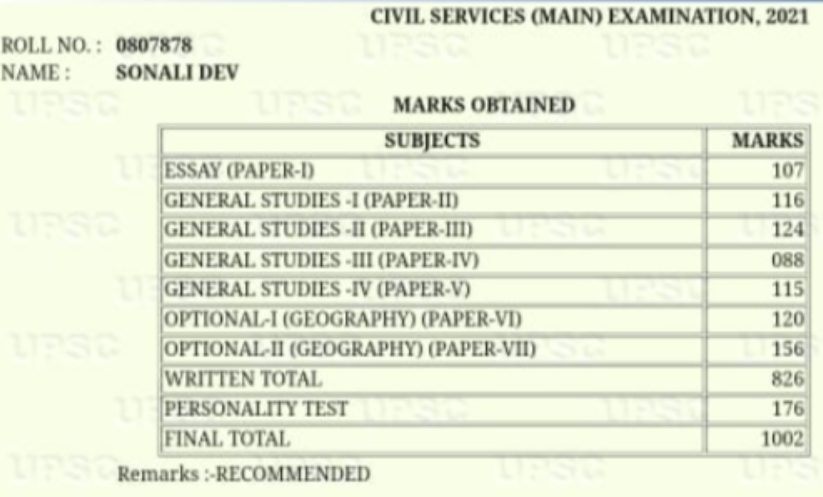
The mains examination is undoubtedly the most important stage of the examination. It would determine whether you find your name in the merit list or not. It is also the most predictable part of the process. I would like to emphasize over a few points that toppers before me have repeatedly said, while adding a few insights of my own.
A Generalist Answer vs A Specific Answer:
Most aspirants writing the examination are from technical backgrounds and have an ingrained sense of writing answers to the point. We have been repeatedly trained to filter out the most important point and write only that. However, the nature of the exam is different from an engineering semester exam and has to be approached accordingly. Here, the requirement is not only to write the most important points, but also write as many dimensions as possible including peripheral points (obviously arranged according to relevancy). You are not only expected to give a brief background/ definition of what has been asked, but also give solutions to address those problems.
Brainstorming Dimensions:
For brainstorming various dimensions to answer a question, there were two approaches I used extensively.
The subject-wise approach:
I always prefer explaining myself through examples. Let’s take a basic question for exemplification. What are the problems of urbanization in India? We can brainstorm various dimensions by recollecting each subject that we have prepared for GS 1-4
- History: Historically only a few Metropolitain cities were established, leading to lopsided development
- Geography: drainage, water issue, urban climate – heat islands
- Indian society: Migration, loss of culture, reducing family ties, individualism
- Polity and Governance: issue of urban governance, wards are unfunctional, taxes are meagre.
- Social Justice: Crime against women, health education facilities are meagre, slums
- Economy: Unemployment, dominated by secondary activities
- Environment: Pollution, congestion
- Science and Tech: rural urban divide – technological divide
- Internal Security: problems of crime, trafficking, narcotics use
- Disaster management: Urban floods, earthquakes
Within a subject keyword approach:
-
- AgricultureMajor cropping patterns in various parts of the country, different types of irrigation and irrigation systems storage, transport and marketing of agricultural produce and issues and related constraints; e-technology in the aid of farmers
- Economics of animal rearing.
- Food processing and related industries in India – scope and significance, location, upstream and downstream requirements, supply chain management.
- Issues related to direct and indirect farm subsidies and minimum support prices; Public Distribution System objectives, functioning, limitations, revamping; issues of buffer stocks and food security; Technology missions
- Land reforms in India.
The above is a verbatim of the GS-3 agriculture syllabus. Again, taking a basic question for illustrative purposes: What is the role of drones in agriculture (e-technology in aid of farmer)?
It can be answered by:
- Cropping pattern: climate mapping, soil mapping
- Irrigation: micro sprinkler irrigation; spraying of fertilizer pesticide
- Storage: warehouse mapping and assessment
- Transportation- through nano drones
- Food processing: automation in packaging
- Subsidies: farm assessment for credit, insurance
- Land reforms: land mapping
Structuring the answer:
We have to understand, that the invigilator checking our papers would be forced to reward us marks based on each sub-part of the question. If we club the subparts, it becomes tedious and time taking for the examiner to segregate each point (something that should have been done by us).
To answer each part of the question, I tried to breakdown each question into various sub-questions and then answered each separately:
“‘Earn while you learn’ scheme needs to be strengthened to make vocational education and skill training meaningful.” Comment. (GS-2, 2021)
The sub parts were:
- Introduction: What is earn while you learn scheme?
- How strengthening earn while you learn would help in Vocational education?
- How strengthening earn while you learn would help in meaningful skill development?
- Other benefits of ‘earn while you learn’?
- How can we Strengthen ‘earn while you learn’?
- Conclusion: What steps have already been taken.
Presentation:
While content of an answer may be central to the question, it is futile if it does not engage the examiner. A few tips I can share for presentation are:
- Subheadings: The above sub questions can be addressed as separate sub-headings.
- Writing a left heavy paperPut all important keyword at the start of every point instead of the end.
- Example: all Data figures, committee names, judgements should be at the left end of the paper. Instead of writing the higher judiciary has only 12% female representation. It can be paraphrased to 12% female judges in higher judiciary.
- The eye quickly catches the most important part of the point, and the rest can be quickly glanced over.
-
- Writing a vertical paperSubheadings can have further headingsHow can we Strengthen ‘earn while you learn’?Policies
- Enrollment
- Awareness
- These sub-points can further be elaborated
- Writing minimum words per answerUse a list of verbs/ adverbs to start a pointExample: Role of women in swadeshi movement?Boycotted liquor shops
- Donated to Tilak Swaraj fund
- Propagated swadeshi and khadi
-
- Cut down on articles (a , an , the) and redundant explanation
Practice:
None of this can come automatically and would require constant practice, till the point that answer writing becomes second nature. I for one, was writing a full length test every third day in between pre and mains, while practicing answer writing daily.
Preparing for UPSC?
Talk to us about the right programme for your attempt.
Keep reading
Related articles
 24
May 2026
24
May 2026
Mains · Answer Writing Strategies
Diagrams for CSE Mains
Hi all, It is well established fact that answer writing in Mains is all about being unique and innovative. Presentation matters more than we think. Reasons to draw diagrams Break monotony of answers. Uniqueness. Despite knowing that diagrams are needed, not many draw them. To…
Decode Civils · 24 May 2026
 23
May 2026
23
May 2026
Mains · Answer Writing Strategies
My Answer Writing Strategy
Answer writing is of course the foundation of CSE MAINS. Once you develop a good answer writing skill, you can be confident of clearing MAINS 10/10 times. My scores in GS: 340 --> 387 --> 426 --> 463. My Strategy involves more than just answer writing. Let’s move in…
Decode Civils · 23 May 2026
 23
May 2026
23
May 2026
Mains · Answer Writing Strategies
When & How To Start Answer Writing Practice?
When To Start? Answer writing is game of both what and how. You must first know what to write and then see how to write. Therefore, you cannot start answer writing till you have not covered fare amount of syllabus. If you start it too early, you won't know what to write and then…
Decode Civils · 23 May 2026
Our programmes
Courses for your attempt

PSIR EXCELLENCE PROGRAM PRO (OFFLINE): Batch-2
An Enrichment Course that can help you add 50+ marks in your PSIR Scores.

PSIR EXCELLENCE PROGRAM PRO (ONLINE): Batch-2
An Enrichment Course that can help you add 50+ marks in your PSIR Scores.

PSIR EXCELLENCE PROGRAM- BASE (OFFLINE): Batch-2
An Enrichment Course that can help you add 50+ marks in your PSIR Scores.
PSIR EXCELLENCE PROGRAM BASE (ONLINE): Batch-2
An Enrichment Course that can help you add 50+ marks in your PSIR Scores.

Mains Excellence Program Pro for Mains 2027 - Final Batch
Your One-Stop Solution for UPSC 2027 Mains: - MEP Faculties have an experience of 22 UPSC CSE Mains, 10 Interviews and 5 Final Selections. - Faculties include Mudit Jain Sir (AIR-222, 207, 173), Sourabh Arbole Sir (6…
Batch 2027 Starts 14 Sep 2026

Mains Excellence Program Plus for Mains 2027 - Final Batch
Your One-Stop Solution for UPSC 2027 Mains: - MEP Faculties have an experience of 22 UPSC CSE Mains, 10 Interviews and 5 Final Selections. - Faculties include Mudit Jain Sir (AIR-222, 207, 173), Sourabh Arbole Sir (6…
Batch 2027 Starts 14 Sep 2026

Mains Excellence Program Basic for Mains 2027 - Final Batch
Your One-Stop Solution for UPSC 2027 Mains: - MEP Faculties have an experience of 22 UPSC CSE Mains, 10 Interviews and 5 Final Selections. - Faculties include Mudit Jain Sir (AIR-222, 207, 173), Sourabh Arbole Sir (6…
Batch 2027 Starts 14 Sep 2026
Foundation + Advanced Ethics Base (Offline)
Is Ethics Paper Doable via Philosophical Gyan or Specific Thematic Preparation is Needed? Last 5 Years' Analysis & 54 Distinct Themes asked by UPSC answer the above question. Thematic preparation and advanced ethics…
Batch 2027 Starts 14 Sep 2026
Foundation + Advanced Ethics Base (Online)
Is Ethics Paper Doable via Philosophical Gyan or Specific Thematic Preparation is Needed? Last 5 Years' Analysis & 54 Distinct Themes asked by UPSC answer the above question. Thematic preparation and advanced ethics…
Batch 2027 Starts 14 Sep 2026
Foundation + Advanced Ethics Plus (Offline)
Is Ethics Paper Doable via Philosophical Gyan or Specific Thematic Preparation is Needed? Last 5 Years' Analysis & 54 Distinct Themes asked by UPSC answer the above question. Thematic preparation and advanced ethics…
Batch 2027 Starts 14 Sep 2026
Foundation + Advanced Ethics Plus (Online)
Is Ethics Paper Doable via Philosophical Gyan or Specific Thematic Preparation is Needed? Last 5 Years' Analysis & 54 Distinct Themes asked by UPSC answer the above question. Thematic preparation and advanced ethics…
Batch 2027 Starts 14 Sep 2026

Year Long Current Affairs Base (Pre + Mains)
Master Current Affairs the way UPSC demands—through conceptual understanding, issue-based analysis, and exam-oriented preparation. With a proven track record across UPSC and State PSC examinations, our course helps you…
Batch 2027 Starts 16 Aug 2026


0 comments
Discussion
No comments yet. Be the first.