
Southwest Monsoon - Factors & Issues
Southwest Monsoon is primary rainy season, contributing over 70% of annual rainfall between June-September. Monsoon winds first reach the Andaman Sea and Bay of Bengal around the third week of May. IMD declares monsoon onset when it reaches Kerala, with the normal onset date…

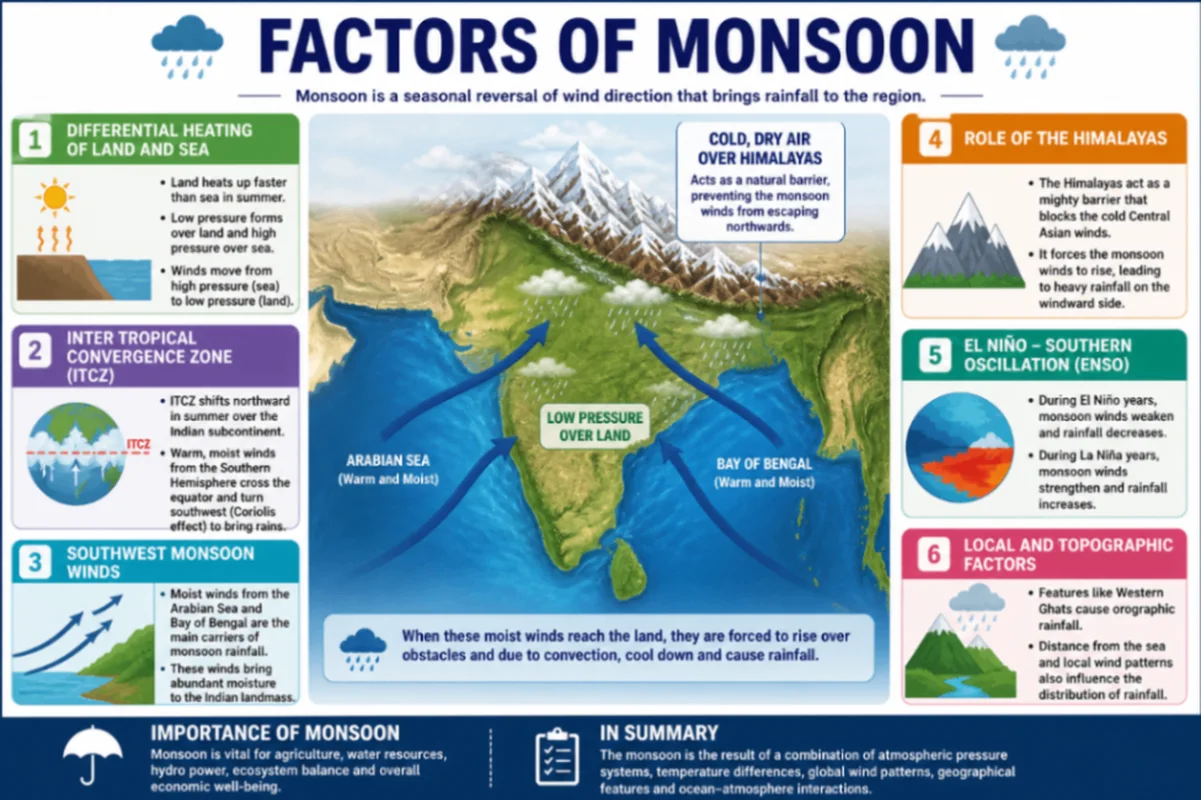
Southwest Monsoon is primary rainy season, contributing over 70% of annual rainfall between June-September. Monsoon winds first reach the Andaman Sea and Bay of Bengal around the third week of May. IMD declares monsoon onset when it reaches Kerala, with the normal onset date being June 1. By around July 15, the monsoon typically covers the entire country. Around 75% of India’s annual rainfall occurs during the four-month monsoon. Long Period Average (LPA) is the average rainfall recorded during June to September over a 50-year period. It serves as a benchmark for forecasting the quantitative monsoon rainfall each year.
Factors of Monsson:
- A low-pressure system over the Arabian Sea favoured early monsoon advancement.
- La-Nina-like conditions in the Pacific Ocean brought good monsoon rainfall last year.
- Madden-Julian Oscillation (MJO) is a moving system of wind, cloud, and pressure that brings rain as it circles around the equator. MJO was identified in 1971 by Roland Madden and Paul Julian. It moves eastward at a speed of 4-8 metres per second and completes a circle around the globe in 30-60 days, sometimes taking up to 90 days. In a favourable phase, the MJO can enhance rainfall over India during the monsoon season.
- Mascarene High is high-pressure area around Mascarene Islands (south Indian Ocean) during monsoon. Variation in the intensity of the Mascarene High is responsible for heavy rains along India’s west coast.
- The Somali jet is a low-level, inter-hemispheric cross-equatorial wind band originating near Mauritius and north Madagascar. During May, after crossing the east coast of Africa, the Somali jet reaches the Arabian Sea and India’s west coast. A strong Somali jet is associated with the strengthening of monsoon winds.
- The low-pressure system along the west coast likely aided 2025's early onset.
- Arctic warming and wind shifts in the Arabian Sea may influence cyclone behaviour.
- Typhoons in the Pacific can also delay the Indian monsoon by diverting moisture.
- Climate change impacts such as polar warming and cyclone trends affect timing and distribution of monsoon.
- ENSO and IOD influence monsoon patterns through sea surface temperature variations. El Nino, with warmer eastern Pacific waters, usually leads to reduced rainfall over India, while La Nina supports better monsoon rains.
- A positive IOD—when the Arabian Sea is warmer than the Bay of Bengal—is favourable for Indian monsoon.
- North America influences and strengthens monsoon over South Asia. During summer, North America warms, altering global air circulation patterns. This warming enhances the North Pacific high-pressure system and shifts the Hadley circulation (Hadley circulation (Hadley cell) is a large-scale tropical circulation with warm air rising at the equator, moving poleward at 12–15 km altitude, cooling and descending near 25° latitude, and returning equatorward near the surface). North America’s influence can even outweigh that of the Tibetan Plateau. South America, Australia, and Antarctica experience smaller or negligible impacts from this phenomenon.
Challenges
- Theories about monsoon onset lack consensus, and El Niño/La Niña do not offer consistent predictability.
- Local and global players influence its trajectory. Role of global warming in influencing onset variability.
- Difficulty in capturing early summer signals.
- Influence of short-term westerly wind bursts and inter-basin interactions (e.g., Indian Ocean anomalies).
- Scientific disagreement over which ocean basin plays the dominant role in ENSO evolution. CLIVAR Pacific Region Panel suggests Recharge Oscillator model can effectively simulate ENSO by representing it as an interaction between sea-surface temperatures in the central-eastern Pacific and subsurface warm water volume in the western Pacific.
Preparing for UPSC?
Talk to us about the right programme for your attempt.
Keep reading
Related articles
 03
May 2026
03
May 2026
Current Affairs · Geography
Coal Distribution & Types
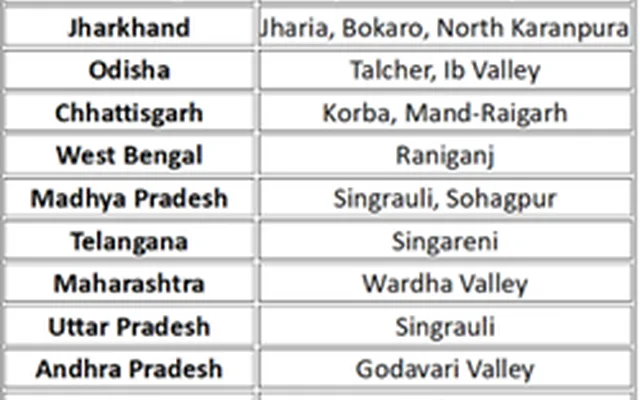
Why in news: Angul district in Odisha is a major hub for coal mining. India's major coal-producing states, consistently leading in output and reserves, are Odisha, Chhattisgarh, Jharkhand, Madhya Pradesh, Telangana, Maharashtra, and West Bengal, with Odisha often topping…
Decode Civils · 3 May 2026
 03
May 2026
03
May 2026
Current Affairs · Geography
Stratospheric Aerosol Injection
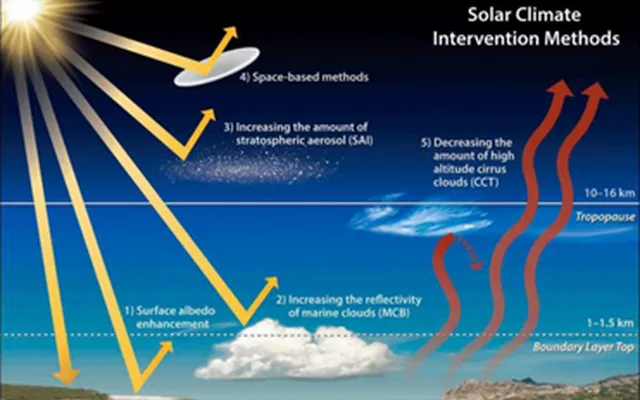
Why in news: SAI involves injecting aerosols into the stratosphere to reflect sunlight and cool the planet. Inspired by volcanic eruptions, which naturally cool Earth by spewing aerosols into the atmosphere. Suggested as a supplement to emissions reductions, not a replacement.…
Decode Civils · 3 May 2026
 03
May 2026
03
May 2026
Current Affairs · Geography
Bharat Forecasting System, IMD & C-FLOOD
Why in news: The government unveiled the new “Bharat Forecasting System” (BFS) for improved weather prediction. The BFS is developed by the Pune-based Indian Institute of Tropical Meteorology (IITM). It will provide weather forecasts with a 6 km resolution, the highest in the…
Decode Civils · 3 May 2026
Our programmes
Courses for your attempt

PSIR EXCELLENCE PROGRAM PRO (OFFLINE): Batch-2
An Enrichment Course that can help you add 50+ marks in your PSIR Scores.

PSIR EXCELLENCE PROGRAM PRO (ONLINE): Batch-2
An Enrichment Course that can help you add 50+ marks in your PSIR Scores.

PSIR EXCELLENCE PROGRAM- BASE (OFFLINE): Batch-2
An Enrichment Course that can help you add 50+ marks in your PSIR Scores.

PSIR EXCELLENCE PROGRAM BASE (ONLINE): Batch-2
An Enrichment Course that can help you add 50+ marks in your PSIR Scores.

Mains Excellence Program Pro for Mains 2027 - Final Batch
Your One-Stop Solution for UPSC 2027 Mains: - MEP Faculties have an experience of 22 UPSC CSE Mains, 10 Interviews and 5 Final Selections. - Faculties include Mudit Jain Sir (AIR-222, 207, 173), Sourabh Arbole Sir (6…
Batch 2027 Starts 14 Sep 2026

Mains Excellence Program Plus for Mains 2027 - Final Batch
Your One-Stop Solution for UPSC 2027 Mains: - MEP Faculties have an experience of 22 UPSC CSE Mains, 10 Interviews and 5 Final Selections. - Faculties include Mudit Jain Sir (AIR-222, 207, 173), Sourabh Arbole Sir (6…
Batch 2027 Starts 14 Sep 2026

Mains Excellence Program Basic for Mains 2027 - Final Batch
Your One-Stop Solution for UPSC 2027 Mains: - MEP Faculties have an experience of 22 UPSC CSE Mains, 10 Interviews and 5 Final Selections. - Faculties include Mudit Jain Sir (AIR-222, 207, 173), Sourabh Arbole Sir (6…
Batch 2027 Starts 14 Sep 2026

Foundation + Advanced Ethics Base (Offline)
Is Ethics Paper Doable via Philosophical Gyan or Specific Thematic Preparation is Needed? Last 5 Years' Analysis & 54 Distinct Themes asked by UPSC answer the above question. Thematic preparation and advanced ethics…
Batch 2027 Starts 14 Sep 2026

Foundation + Advanced Ethics Base (Online)
Is Ethics Paper Doable via Philosophical Gyan or Specific Thematic Preparation is Needed? Last 5 Years' Analysis & 54 Distinct Themes asked by UPSC answer the above question. Thematic preparation and advanced ethics…
Batch 2027 Starts 14 Sep 2026

Foundation + Advanced Ethics Plus (Offline)
Is Ethics Paper Doable via Philosophical Gyan or Specific Thematic Preparation is Needed? Last 5 Years' Analysis & 54 Distinct Themes asked by UPSC answer the above question. Thematic preparation and advanced ethics…
Batch 2027 Starts 14 Sep 2026

Foundation + Advanced Ethics Plus (Online)
Is Ethics Paper Doable via Philosophical Gyan or Specific Thematic Preparation is Needed? Last 5 Years' Analysis & 54 Distinct Themes asked by UPSC answer the above question. Thematic preparation and advanced ethics…
Batch 2027 Starts 14 Sep 2026

Year Long Current Affairs Base (Pre + Mains)
Master Current Affairs the way UPSC demands—through conceptual understanding, issue-based analysis, and exam-oriented preparation. With a proven track record across UPSC and State PSC examinations, our course helps you…
Batch 2027 Starts 16 Aug 2026


0 comments
Discussion
No comments yet. Be the first.