
Stratospheric Aerosol Injection
Why in news: SAI involves injecting aerosols into the stratosphere to reflect sunlight and cool the planet. Inspired by volcanic eruptions, which naturally cool Earth by spewing aerosols into the atmosphere. Suggested as a supplement to emissions reductions, not a replacement.…

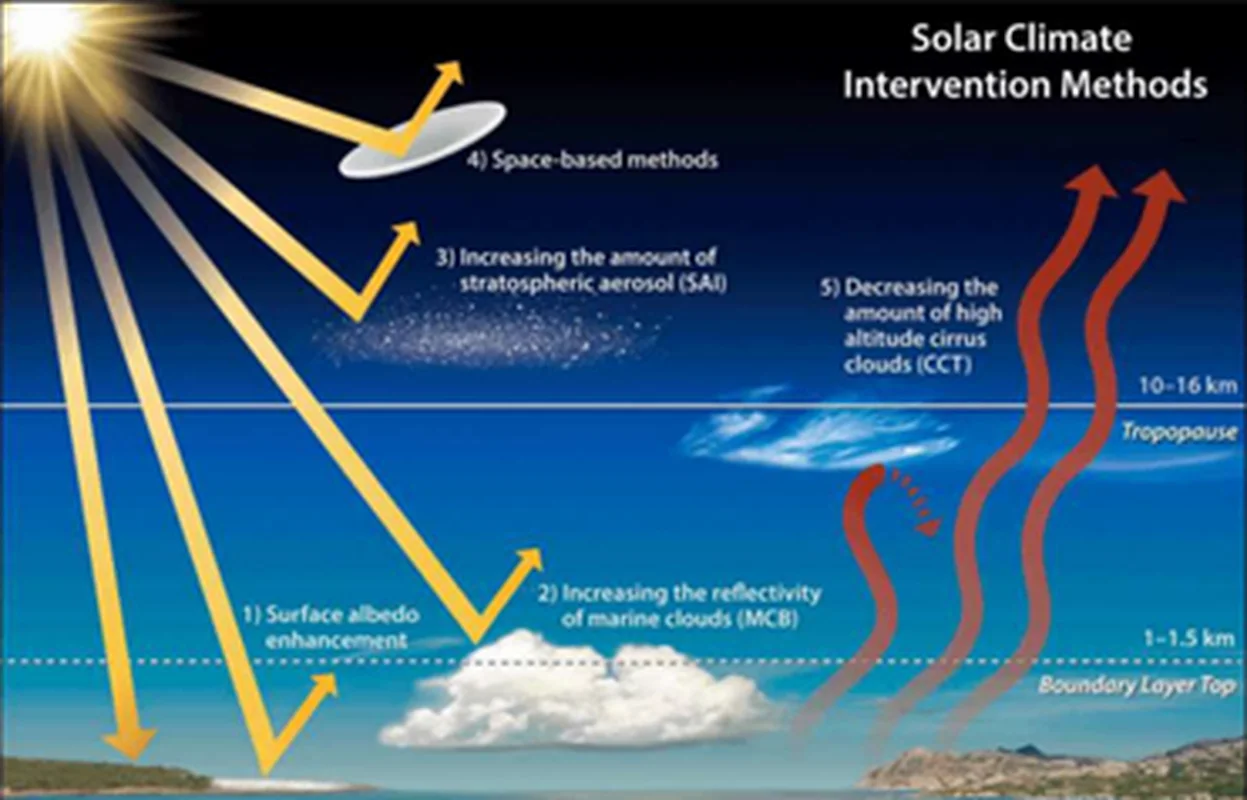
Why in news: SAI involves injecting aerosols into the stratosphere to reflect sunlight and cool the planet. Inspired by volcanic eruptions, which naturally cool Earth by spewing aerosols into the atmosphere. Suggested as a supplement to emissions reductions, not a replacement.
- Traditional SAI focuses on high-altitude injections (20 km+), requiring specially designed aircraft. New approach proposes lower-altitude injections (13 km) in polar and extratropical regions.
- 12 mn tonnes/yr of sulphur dioxide, sulphur aerosols, titanium dioxide or calcium carbonate at 13km could cool planet by 0.6°C. Lower altitude injections are cheaper and quicker.
Challenges
- Lower altitude injections risk aerosols being washed out by rain, reducing long-term effectiveness.
- May cause ozone depletion, acid rain, and delayed ozone hole recovery.
- Cooling effect is stronger at the poles but less effective where warming is most severe (tropics).
- Sea Curtains/ Walls: Blocking warm ocean water from reaching ice using buoyant structures attached to seabed.
- Sea Ice Management: Scattering glass microbeads to increase ice reflectivity and thickness.
- Basal Water Removal: Removing subglacial water under glaciers to slow ice movement and sea-level rise.
- Ocean Fertilisation: Adding nutrients like iron to oceans to stimulate phytoplankton growth and absorb more CO₂.
Concerns with Stratospheric Aerosol Injection (SAI)
- Research focuses on sulphur dioxide, sulphur aerosols, titanium dioxide, and calcium carbonate.
- Ineffective in polar winters (no sunlight to reflect) and redundant in summers due to existing natural reflectivity.
- Risk of termination shocks — sudden temperature spikes if stopped.
- Could disrupt global weather patterns, affecting food and national security.
Concerns with Sea Curtains and Sea Walls
- High logistical costs in remote regions like the Amundsen Sea.
- May cause negative impacts on ocean circulation and marine life.
Concerns with Sea Ice Management
- Ecotoxicity concerns and possible harm to zooplankton.
- Requires 360 million tonnes of glass microbeads annually — equal to global plastic production.
Concerns with Basal Water Removal and Ocean Fertilisation
- Basal Water Removal is emissions-intensive, needs constant monitoring, and offers limited impact.
- Ocean Fertilisation causes uncontrolled phytoplankton growth, disrupting food chains and nutrient cycles.
Preparing for UPSC?
Talk to us about the right programme for your attempt.
Keep reading
Related articles
 03
May 2026
03
May 2026
Current Affairs · Geography
Coal Distribution & Types
Why in news: Angul district in Odisha is a major hub for coal mining. India's major coal-producing states, consistently leading in output and reserves, are Odisha, Chhattisgarh, Jharkhand, Madhya Pradesh, Telangana, Maharashtra, and West Bengal, with Odisha often topping…
Decode Civils · 3 May 2026
 03
May 2026
03
May 2026
Current Affairs · Geography
Bharat Forecasting System, IMD & C-FLOOD
Why in news: The government unveiled the new “Bharat Forecasting System” (BFS) for improved weather prediction. The BFS is developed by the Pune-based Indian Institute of Tropical Meteorology (IITM). It will provide weather forecasts with a 6 km resolution, the highest in the…
Decode Civils · 3 May 2026
 03
May 2026
03
May 2026
Current Affairs · Geography
Southwest Monsoon - Factors & Issues
Southwest Monsoon is primary rainy season, contributing over 70% of annual rainfall between June-September. Monsoon winds first reach the Andaman Sea and Bay of Bengal around the third week of May. IMD declares monsoon onset when it reaches Kerala, with the normal onset date…
Decode Civils · 3 May 2026
Our programmes
Courses for your attempt

PSIR EXCELLENCE PROGRAM PRO (OFFLINE): Batch-2
An Enrichment Course that can help you add 50+ marks in your PSIR Scores.

PSIR EXCELLENCE PROGRAM PRO (ONLINE): Batch-2
An Enrichment Course that can help you add 50+ marks in your PSIR Scores.

PSIR EXCELLENCE PROGRAM- BASE (OFFLINE): Batch-2
An Enrichment Course that can help you add 50+ marks in your PSIR Scores.

PSIR EXCELLENCE PROGRAM BASE (ONLINE): Batch-2
An Enrichment Course that can help you add 50+ marks in your PSIR Scores.

Mains Excellence Program Pro for Mains 2027 - Final Batch
Your One-Stop Solution for UPSC 2027 Mains: - MEP Faculties have an experience of 22 UPSC CSE Mains, 10 Interviews and 5 Final Selections. - Faculties include Mudit Jain Sir (AIR-222, 207, 173), Sourabh Arbole Sir (6…
Batch 2027 Starts 14 Sep 2026

Mains Excellence Program Plus for Mains 2027 - Final Batch
Your One-Stop Solution for UPSC 2027 Mains: - MEP Faculties have an experience of 22 UPSC CSE Mains, 10 Interviews and 5 Final Selections. - Faculties include Mudit Jain Sir (AIR-222, 207, 173), Sourabh Arbole Sir (6…
Batch 2027 Starts 14 Sep 2026

Mains Excellence Program Basic for Mains 2027 - Final Batch
Your One-Stop Solution for UPSC 2027 Mains: - MEP Faculties have an experience of 22 UPSC CSE Mains, 10 Interviews and 5 Final Selections. - Faculties include Mudit Jain Sir (AIR-222, 207, 173), Sourabh Arbole Sir (6…
Batch 2027 Starts 14 Sep 2026
Foundation + Advanced Ethics Base (Offline)
Is Ethics Paper Doable via Philosophical Gyan or Specific Thematic Preparation is Needed? Last 5 Years' Analysis & 54 Distinct Themes asked by UPSC answer the above question. Thematic preparation and advanced ethics…
Batch 2027 Starts 14 Sep 2026
Foundation + Advanced Ethics Base (Online)
Is Ethics Paper Doable via Philosophical Gyan or Specific Thematic Preparation is Needed? Last 5 Years' Analysis & 54 Distinct Themes asked by UPSC answer the above question. Thematic preparation and advanced ethics…
Batch 2027 Starts 14 Sep 2026

Foundation + Advanced Ethics Plus (Offline)
Is Ethics Paper Doable via Philosophical Gyan or Specific Thematic Preparation is Needed? Last 5 Years' Analysis & 54 Distinct Themes asked by UPSC answer the above question. Thematic preparation and advanced ethics…
Batch 2027 Starts 14 Sep 2026

Foundation + Advanced Ethics Plus (Online)
Is Ethics Paper Doable via Philosophical Gyan or Specific Thematic Preparation is Needed? Last 5 Years' Analysis & 54 Distinct Themes asked by UPSC answer the above question. Thematic preparation and advanced ethics…
Batch 2027 Starts 14 Sep 2026

Year Long Current Affairs Base (Pre + Mains)
Master Current Affairs the way UPSC demands—through conceptual understanding, issue-based analysis, and exam-oriented preparation. With a proven track record across UPSC and State PSC examinations, our course helps you…
Batch 2027 Starts 16 Aug 2026


0 comments
Discussion
No comments yet. Be the first.