
Presidential Reference & Various Articles
Why in news: SC’s decision in the Tamil Nadu Governor case imposed a three-month timeline for the President to act on Bills under Article 201. The Centre raised a Presidential Reference. Reference asked if a judiciary can prescribe a time limit for the President when Article 201…

Why in news: SC’s decision in the Tamil Nadu Governor case imposed a three-month timeline for the President to act on Bills under Article 201. The Centre raised a Presidential Reference.
- Reference asked if a judiciary can prescribe a time limit for the President when Article 201 does not specify one.
- The three-month timeline was based on the 2016 MHA guidelines & OMs. Sarkaria and Punchhi Commissions had recommended expedited decisions on State Bills referred to the President. For ordinances of urgent nature, a three-week disposal timeline was prescribed. The second OM mandated that objections from ministries must be shared with the concerned State government, with a one-month response time.
- Notable Past References: SC declined only once — the Ram Janmabhoomi reference (1993).
- 42nd Amendment made Article 74(1) explicit that the President must act according to Cabinet advice, Article 163 (Governor’s powers) was not amended in the same way
Constitutional Provisions
- Article 141: Law declared by the Supreme Court is binding on all courts within the territory of India. This provision ensures that there is a uniform and consistent application of laws across the country.
- Article 143: The President may refer any question of law or fact of public importance to the SC for an advisory opinion, based on Cabinet advice. The advisory jurisdiction under Article 143 is inherited from GoI Act, 1935, which allowed the Governor-General to refer questions to the federal court. A similar advisory mechanism exists in Canada, while the U.S. Supreme Court refrains from such opinions due to strict separation of powers. SC must limit itself to the questions referred and cannot exceed the scope of the Reference. Advisory opinions under Article 143 are not binding, but have persuasive value.
- The Constitution is silent on whether an opinion given by the Supreme Court under Article 143 can overrule a binding judgment. Article 144 states that all authorities, civil and judicial, in the territory of India shall act in aid of the Supreme Court. Articles 141 and 144, read together, make it clear that the law declared through judgments of the Supreme Court is binding, and all authorities are bound to comply. It is argued that an advisory opinion may even go so far as to “overrule, if necessary” an earlier judgment.
- Article 145(3): The reference must be heard by a bench of at least five judges.
- Under Article 167, the Chief Minister must keep the Governor informed on contemplated laws, enabling pre-legislative consultation, but assent after passage is mandatory.
- Article 200: Options for Governor Assent, withhold assent, return for reconsideration (except for Money Bills), or reserve the bill for the President's consideration. The Governor can also return the bill to the legislature for reconsideration, but must give assent if the bill is passed again. Governor enjoys discretion in choosing among these options and is not bound by the aid and advice of the Council of Ministers. Under the GoI Act, 1935, both the Governor-General and the Governor had discretion (Sections 32 and 75) to assent, withhold, or return Bills.
- Article 201: Deals with Bills reserved by the Governor for the President's consideration, granting the President power to assent, withhold assent, or return the bill for reconsideration.
- Article 254(1): If a State law conflicts with a valid Central law on a Concurrent List subject, the Central law takes precedence, rendering the State law void to the extent of the repugnancy.
- Article 254(2): A State law repugnant to a Central law can prevail within that State if it's reserved for the President's consideration and receives their assent, overriding the Central law in that specific state.
- Proviso to 254(2): Parliament retains the power to enact a new law on the same subject at any time, even after the President's assent, further amending, varying, or repealing the State law.

Can Article 143 Be Used to Overturn a Ruling? (As per various newspaper articles before opinion in this case came):
- Article 143 cannot be used by the executive to seek review or reversal of SC rulings. Only review or curative petitions can challenge settled SC judgments. Cauvery Water Disputes Reference clarified this principle.
- Constitution does not permit SC to act as an appellate court over itself, nor can the President vest appellate jurisdiction through Article 143. SC may clarify or restate law under Article 143(1) if the earlier ratio decidendi remains intact.
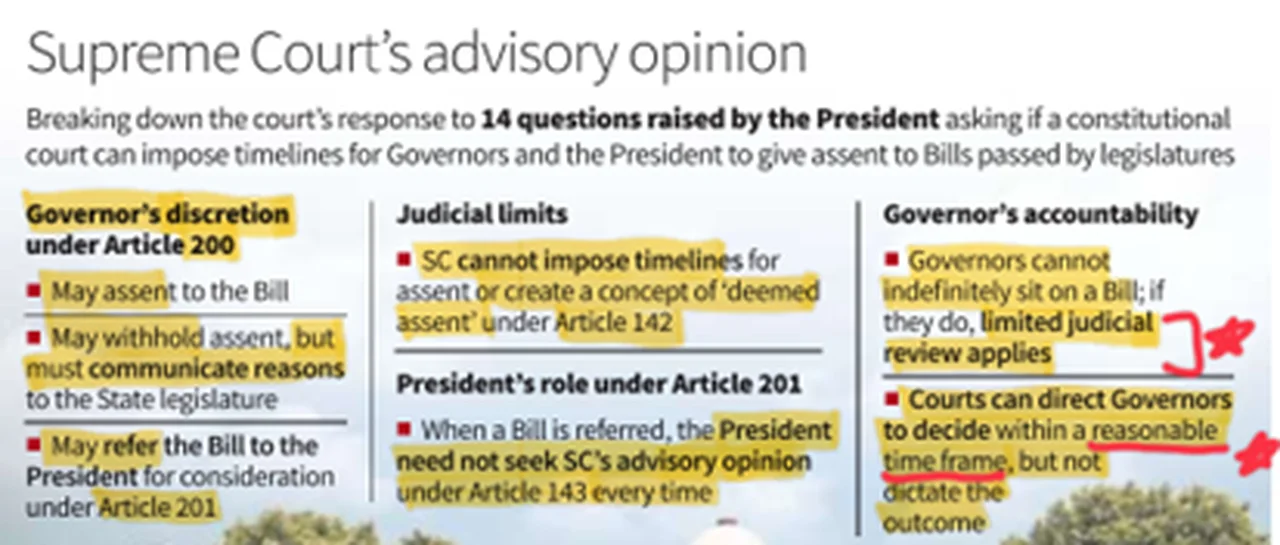
- A five-judge Bench delivered the opinion, calling it a “functional reference” as it deals with day-to-day functioning of constitutional functionaries and the interplay between the State legislature, Governor, and President.
- Governor’s actions under Article 200 are not justiciable, but in exceptional cases of prolonged and unexplained inaction, Court may issue a limited mandamus directing the Governor to act.
- The Court stated it cannot prescribe timelines for the President or Governor, since none exist in the Constitution.
- Decisions of the President (Article 201) and Governor (Article 200) are not justiciable before a Bill becomes law.
- Court held that Article 142 cannot substitute constitutional powers of President or Governor, and thus “deemed assent” is not permissible.

- Earlier rulings including Shamsher Singh (1974) & Nabam Rebia (2016) had held that Governors must act on the aid and advice of the COM.
- Punchhi Commission (2010) recommended that Governors should decide on Bills within 6 months. In K.M. Singh (2020), the Court prescribed a three-month limit for Speakers on disqualification petitions, though no constitutional timeline existed.
Preparing for UPSC?
Talk to us about the right programme for your attempt.
Keep reading
Related articles
 03
Jul 2026
03
Jul 2026
Current Affairs · Polity
Gram Sabhas and Panchayats
The Hindu, Page 6, Editorial - Yes and no - GS-2-Polity Why in News: A Rural Development Ministry report based on surveys examines citizen participation in gram sabhas and highlights concerns over participation fatigue.…
Decode Civils · 3 Jul 2026
 25
Apr 2026
25
Apr 2026
Current Affairs · Polity
Women Reservation
What: The Legal Framework The core of this reservation lies in the 106th Constitutional Amendment Act, 2023 (Nari Shakti Vandan Adhiniyam). The Mandate: It reserves 33% (one-third) of seats for women in the Lok Sabha, State Legislative Assemblies, and the Delhi Legislative…
Decode Civils · 25 Apr 2026
 25
Apr 2026
25
Apr 2026
Current Affairs · Polity
16th Finance Commission
Why in news: 16th FC recommended that Centre retain 41% share of tax devolution to States as in force since 2021. ₹1.4 lakh crore States Grant include Rural and Urban Local Body and Disaster Management Grants. It tweaked formula that decides the division of the share among the…
Decode Civils · 25 Apr 2026
Our programmes
Courses for your attempt

PSIR EXCELLENCE PROGRAM PRO (OFFLINE): Batch-2
An Enrichment Course that can help you add 50+ marks in your PSIR Scores.

PSIR EXCELLENCE PROGRAM PRO (ONLINE): Batch-2
An Enrichment Course that can help you add 50+ marks in your PSIR Scores.

PSIR EXCELLENCE PROGRAM- BASE (OFFLINE): Batch-2
An Enrichment Course that can help you add 50+ marks in your PSIR Scores.
PSIR EXCELLENCE PROGRAM BASE (ONLINE): Batch-2
An Enrichment Course that can help you add 50+ marks in your PSIR Scores.

Mains Excellence Program Pro for Mains 2027 - Final Batch
Your One-Stop Solution for UPSC 2027 Mains: - MEP Faculties have an experience of 22 UPSC CSE Mains, 10 Interviews and 5 Final Selections. - Faculties include Mudit Jain Sir (AIR-222, 207, 173), Sourabh Arbole Sir (6…
Batch 2027 Starts 14 Sep 2026

Mains Excellence Program Plus for Mains 2027 - Final Batch
Your One-Stop Solution for UPSC 2027 Mains: - MEP Faculties have an experience of 22 UPSC CSE Mains, 10 Interviews and 5 Final Selections. - Faculties include Mudit Jain Sir (AIR-222, 207, 173), Sourabh Arbole Sir (6…
Batch 2027 Starts 14 Sep 2026

Mains Excellence Program Basic for Mains 2027 - Final Batch
Your One-Stop Solution for UPSC 2027 Mains: - MEP Faculties have an experience of 22 UPSC CSE Mains, 10 Interviews and 5 Final Selections. - Faculties include Mudit Jain Sir (AIR-222, 207, 173), Sourabh Arbole Sir (6…
Batch 2027 Starts 14 Sep 2026
Foundation + Advanced Ethics Base (Offline)
Is Ethics Paper Doable via Philosophical Gyan or Specific Thematic Preparation is Needed? Last 5 Years' Analysis & 54 Distinct Themes asked by UPSC answer the above question. Thematic preparation and advanced ethics…
Batch 2027 Starts 14 Sep 2026
Foundation + Advanced Ethics Base (Online)
Is Ethics Paper Doable via Philosophical Gyan or Specific Thematic Preparation is Needed? Last 5 Years' Analysis & 54 Distinct Themes asked by UPSC answer the above question. Thematic preparation and advanced ethics…
Batch 2027 Starts 14 Sep 2026
Foundation + Advanced Ethics Plus (Offline)
Is Ethics Paper Doable via Philosophical Gyan or Specific Thematic Preparation is Needed? Last 5 Years' Analysis & 54 Distinct Themes asked by UPSC answer the above question. Thematic preparation and advanced ethics…
Batch 2027 Starts 14 Sep 2026
Foundation + Advanced Ethics Plus (Online)
Is Ethics Paper Doable via Philosophical Gyan or Specific Thematic Preparation is Needed? Last 5 Years' Analysis & 54 Distinct Themes asked by UPSC answer the above question. Thematic preparation and advanced ethics…
Batch 2027 Starts 14 Sep 2026

Year Long Current Affairs Base (Pre + Mains)
Master Current Affairs the way UPSC demands—through conceptual understanding, issue-based analysis, and exam-oriented preparation. With a proven track record across UPSC and State PSC examinations, our course helps you…
Batch 2027 Starts 16 Aug 2026


0 comments
Discussion
No comments yet. Be the first.